There's an old joke about how you eat an elephant. One piece at a time, right?
For the best part of a decade, that was the unofficial motto of digital health. Incremental. Careful. One small win at a time. And while that approach had its merits, if you look at the size of the challenge facing the NHS right now, eating the elephant one piece at a time simply isn't going to cut it anymore.The question is whether we're finally ready to take on the whole feast.
That's the conversation we had recently with Dr Umang Patel, CCIO at Microsoft and one of the first ten employees at Babylon Health. Umang is a paediatrician by training, a health tech pioneer by instinct, and one of the sharpest thinkers on the intersection of clinical leadership and technology. Umang has been a close friend of DrDoctor since 2012 - what we affectionately call the class of 2012 - and looking back, it feels like we've spent the last fourteen years preparing for the moment we're now in.
The Class of 2012: We were right, just too early
Cast your mind back to 2012. A small group of people genuinely believed they were about to transform healthcare. The concepts were right. The hypotheses were right. The energy was extraordinary.
Umang joined Babylon Health in those early days, drawn in by a founder who said two things that were almost impossible to argue with. First: let's stop talking about it and just do it. Second: if anyone else is offering you the chance to change the world and pay off your mortgage, great - if not, I'll see you on Monday.
That culture - bold, fast, slightly chaotic - produced something remarkable. Babylon launched in the UK and Rwanda simultaneously, on the logic that if you could make it work in one of the world's most developed health systems and one of the least developed, everything in between would be easy. Mad? Yes. Effective? Also yes.
But something happened between then and now. That "just do it" energy got beaten out of the system. The thought of launching something with Babylon's ambition and scale in the UK today feels further away than it did in 2012. Big, bold homegrown health tech innovation has increasingly given way to caution, process, and a tendency to wait for someone else to go first.
It's a shame. And it's something we need to fix.
COVID: The punch we needed
Before the fallow period came the false dawn.
Between 2016 and 2019, the mood in digital health was electric. Personalised medicine. Genomic sequencing. AI diagnostics. We genuinely thought we were about to win medicine. And then COVID arrived and reminded everyone, very firmly, that we weren't quite as clever as we thought.
Covid was a literal and metaphorical punch in the face.
But here's the thing about getting punched in the face. Sometimes you need it.
COVID did something that years of advocacy, pilots, and policy papers had failed to do. It proved, beyond any doubt, that people would use digital tools for healthcare. The barriers that had felt insurmountable - patient adoption, clinician resistance, information governance anxiety - crumbled almost overnight. We shifted care online. We engaged with patients in entirely new ways. We proved it could be done.
The hangover was real. The fallow period that followed was painful. But the foundation that was laid during those years? That's what everything else is now being built on.
The colour screen moment
If you want to understand where we are right now with AI in healthcare, think about the first colour mobile phone screen.
Objectively, it didn't do very much. A colour screen on a phone that couldn't take pictures or browse the internet wasn't exactly transformative. But it was magic. It made people stop and stare. And more importantly, it made people ask: if it can do that, what else can it do?
AI ambient voice transcription - the scribes that are now finding their way into GP surgeries and hospital wards across the UK - is healthcare's colour screen moment.
On the surface, it takes notes. Useful, sure. But the real unlock isn't the note-taking. It's the feeling clinicians get when they realise they can stop staring at a screen and start looking at their patient again. That moment - of going back to doing the thing they trained for, the thing they actually love - is changing how doctors and nurses think about what technology can do for them.
And once you've had that feeling, you start asking bigger questions. What else can I do differently? How can I get better information without making my patient fill in another paper form? How can I make this whole system work better for the people in it?
That's the door the scribes are opening. And what's behind it is extraordinary.
The MDT of the future
Here's where it gets really exciting.
Picture a standard NHS multidisciplinary team meeting. Twenty brilliant clinicians in a room, drawing on decades of combined expertise, making complex decisions about a patient's care. It's one of the most sophisticated things that happens in any health system anywhere in the world.
And then someone writes one sentence in the notes. Because that's all there's time for.
The richness of that conversation - the nuance, the debate, the reasoning - disappears. Gone. And the patient never benefits from most of what was said in that room.
Now imagine a different version. Agents listening, documenting, and synthesising in real time. The full richness of the MDT captured, structured, and added to a growing corpus of knowledge about that patient. Those same agents reaching out to the patient between appointments, gathering new information, bringing it back into the next conversation. Clinicians who aren't in the same room - or even the same city - contributing meaningfully to the discussion. A personalised care team that exists not just in that one-hour meeting, but continuously, around the patient's actual life.
That is where things are going. Multi-human, multi-agent teams collaborating on patient care in ways that simply weren't possible before.
The NHS is the world's best AI training ground
Here's something that doesn't get said enough: the NHS has an extraordinary competitive advantage in the AI race.
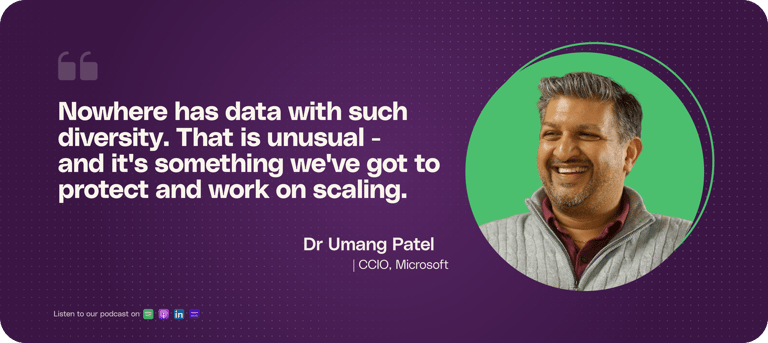
The second largest healthcare market in the world outside the United States isn't Germany, or Japan, or China. It's the UK. And unlike the fragmented, payer-driven US system, the NHS is a single, coherent entity - one that has been collecting patient data, at scale, across one of the most diverse populations on the planet.
Diversity matters enormously here. Walk into any NHS hospital and you encounter a breadth of languages, ethnicities, conditions, and experiences that almost no other health system in the world can match. An AI trained on NHS data isn't just trained on a large dataset. It's trained on a genuinely representative one.
The NHS can be the Hogwarts for AI in healthcare. If we can prove it here, we can prove it anywhere.
That's an extraordinary position to be in. And it's one we should be protecting and exploiting far more aggressively than we currently are.
The revolution will be clinically led
One thread ran through the whole conversation: the next wave of NHS transformation isn't going to come from the top down. It's going to come from clinicians who have decided that no one is coming to save them, and that they're going to have to take matters into their own hands.
That's not a criticism of leadership. It's actually an incredibly exciting development.
For too long, clinicians were the afterthought in the innovation room - brought in to validate ideas that had been developed without them, rather than being the ones driving the agenda. The most successful clinical entrepreneurs have always been those who could look up from their specialism and see the bigger picture. Medicine trains people to be curious, to diagnose, to ask the right questions. Those are exactly the skills great entrepreneurs need.
What's changing now is that the tooling has caught up with the ambition. You no longer need to know how to code to build a proof of concept. You no longer need to choose between your clinical career and your entrepreneurial instincts. The infrastructure is there. The network is there. The energy - and there is real energy right now - is there.
And here's perhaps the most encouraging data point of all: being a doctor in the NHS is the number one career aspiration among 13 to 15 year olds in the UK, for the third year running.
The talent is coming. The tools are ready. The foundation has been laid.
Time to take on the feast
Fourteen years ago, two people who barely knew each other sat at the beginning of what felt like the most exciting moment in healthcare. They were right that it was exciting. They were wrong about the timeline.
The concepts were always correct. The direction of travel was always clear. It just took longer than anyone hoped, went through more turbulence than anyone expected, and required a global pandemic to prove some of the basics that should never have been in doubt.
But here we are. The colour screen moment has happened. The clinical energy is building. The data advantage is real. The tools are genuinely capable of something transformative.
The elephant is still there. It's still enormous. But for the first time in a while, it really feels like we're ready to take it on - not one cautious piece at a time, but properly, boldly, and at the scale the NHS and its patients deserve.
This post is based on a conversation with Umang Patel, CCIO at Microsoft, on the DrDoctor Will See You Now podcast - Eating the Elephant: From Babylon Beginnings to AI-Powered Hospitals. Listen now wherever you get your podcasts.