
The outpatient follow-up problem isn't new. Neither is the case for remote patient monitoring. What's changed is the conditions that make it scalable.
Jane's alarm goes off at 6:45.
She gets the kids up, bundles them into the car, drops them at her mum's. She drives across town, circles the car park twice, gives up, and mounts the kerb. She follows the signs to the right waiting room - third floor, turn left, then left again. She waits 40 minutes.
She's seen for seven.
"Yep, all looks good to me."
She walks back to her car and finds a parking ticket under the wiper. She sits down, stares at it for a moment, and thinks what a lot of people think at least once in their patient journey:
Did that really have to be in person?
In Jane's case - it didn't. She's a stable patient on a routine follow-up pathway. Her results were fine. Her appointment could have been an online check-in, reviewed by her clinician in minutes, from anywhere. But the pathway didn't know that until she showed up. So she showed up.
Multiply that by 44 million follow-up appointments a year, and you start to understand the scale of what's at stake.
Appetite has never been the problem
Ask a head of elective care whether all their follow-ups need to be face-to-face.
They'll tell you no.
Ask a consultant whether they'd rather spend clinic time on patients who genuinely need them, or a patient whether they'd prefer a digital check-in to Jane's morning. You know the answer. Clinicians know which appointments add value and which don't. Patients feel it. Operational teams carry the cost of it every single day.
So why, with a 25% national follow-up reduction target set in 2019, had the number barely moved by 2022-2023?
Because appetite alone doesn't move pathways. And a few things always get in the way:
The first is clinical risk. Pathways that move patients away from routine in-clinic appointments have to be safe. Not safe in theory - safe for this patient population, this specialty, this trust's clinical context. Without that evidence, no consultant is signing off on it (and rightly so).
Then there's operational complexity. You can't drop new technology or ways of working onto a clinical team and expect adoption. The pathway has to be built around how that team actually operates - their escalation logic, their definition of what stable looks like. That takes someone willing to do the work on the ground.
And for years, incentive pointed in another direction. The payment model had one logic: see more patients, get paid more. The Elective Recovery Fund, introduced after the pandemic, put more money behind that logic - rewarding trusts for hitting activity targets above pre-pandemic levels. More new patient activity, more income. It worked for what it was designed to do.
But it didn't leave much room for the follow-up question. If volume is what gets rewarded, there's no obvious financial case for replacing a clinic slot with a digital check-in - even when the clinical case is clear.
That's what's changing. From proposed changes in April 2026, trusts can receive £33 for every RTT clock stop that doesn't require a face-to-face appointment. The payment model is starting to recognise what clinicians have known for years: a stable patient safely managed remotely is a good outcome, not a missed opportunity.
Out of sight does not have to mean out of mind.
Why most attempts at this have failed
The trusts that tried to move patients onto digital pathways and stalled didn't fail because the software didn't work. They failed because the pathway underneath wasn't built for the people it was supposed to serve.
Take rheumatology. One trust built a patient remote monitoring pathway around a single consultant's cohort, scoring methodology, and EPR workflow - not a generic template dropped on top of it. PIFU adoption went from 2.6% to 14.2%. Wait times dropped by nearly 50%. Over 1,500 clinic hours saved per year. The results were published independently in a peer-reviewed journal - which tells you something about the confidence behind them.
Contrast that with another trust, where consultants wouldn't move patients onto digital pathways until the outcoming function matched their actual workflow - two specific buttons built into the EPR, reflecting how they made clinical decisions. Once the design fit the clinical logic, adoption followed. We've also seen a digital monitoring pathway built around local context for cancer follow-ups, which resulted in a 45% reduction in overall follow-up attendance. Consultants reviewing four times as many patients digitally as face-to-face.
What a hybrid pathway actually does
A hybrid pathway is designed to offer more flexibility for people like Jane and the care team around her.
Instead of a patient being automatically booked in for a face-to-face appointment in six months, the pathway collects information - symptoms, scores, self-reported data - and routes them based on what that data shows. Stable patients stay on the remote pathway. Patients whose responses trigger a clinical flag get a task created, assigned to the right team member, with the patient context already attached. From there, the clinician makes the call if they need to be seen in clinic or not.
This keeps the clinician firmly in the picture, but freed up for the patients who actually need them most. It's what data-led care delivery looks like in practice - not replacing clinical judgement, but making sure it's protected for where it matters most.
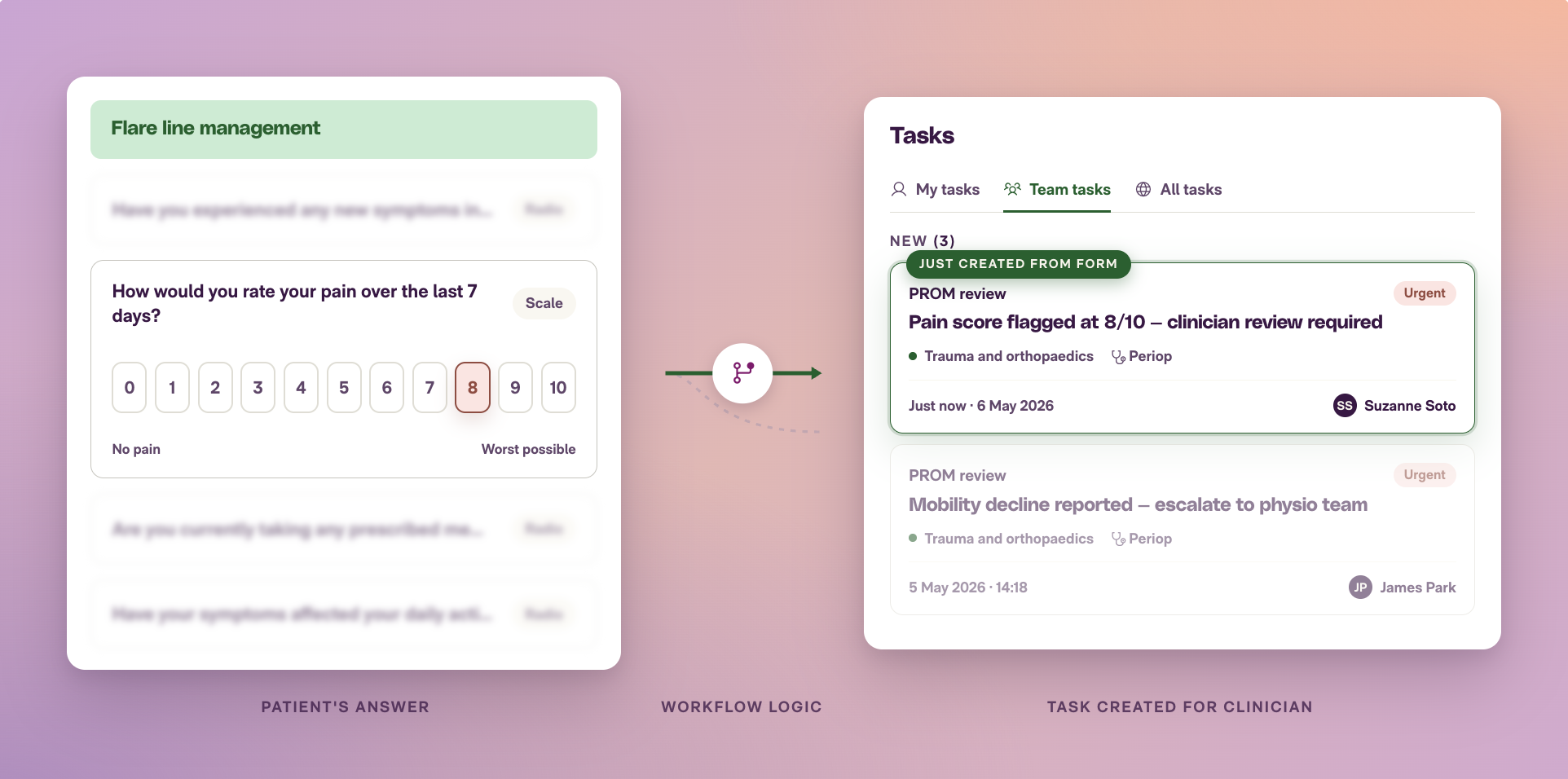
That model works across different specialties and use cases - from pre-operative screenings and remote patient monitoring, to PIFU and active surveillance.
The key to starting is starting small. Pick one specialty. One cohort. Deploy, see the data, build the evidence, then expand. We've seen it work - Bradford Teaching Hospitals reduced nurse callbacks by 30% starting with a single rheumatology pathway.
The practical question now
With the payment model shifting, many are now rethinking where best to start.
That answer is different for every trust. It depends on your specialty mix, your existing personalised follow-up adoption, your clinical appetite for change, and which service managers are ready to move. There's no universal answer - but there are patterns from the trusts that have done it, and the adoption rates to show what's possible when the conditions are right.
These pathways exist, the clinical evidence is growing, and the financial case is finally catching up. The question is whether you've got the infrastructure to capture it.