The appointment booking crisis hiding in plain sight
Every year, the NHS books millions of outpatient appointments that never happen. Not because patients don't need care. Not because clinicians aren't working hard enough. But because the system itself is designed in a way that almost guarantees failure.
At Imperial College Healthcare, Deputy Director of Operations Milica Stjepanovic saw this problem up close. The numbers were stark: 1.7 million appointments booked, 1.2 million attended. Half a million appointments lost to cancellations, rebookings and no-shows - year after year.
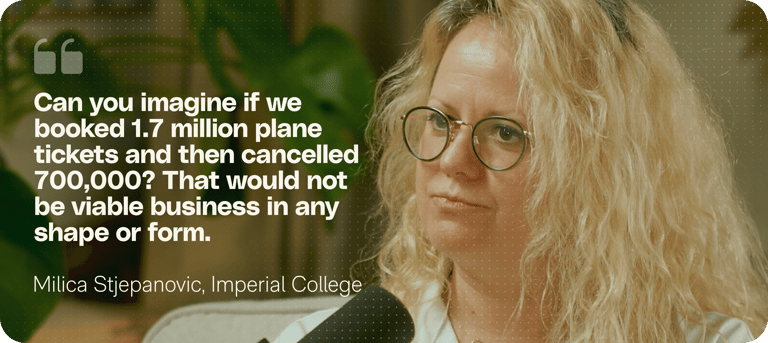
Can you imagine if we booked 1.7 million plane tickets and then cancelled 700,000? That would not be viable business in any shape or form.
So why has our healthcare system accepted it as the norm?
The hidden cost of the cancellation spiral
The waste is not just statistical. It is operational, financial and cultural.
Every cancellation triggers a cascade. A booking letter. A cancellation letter. A rescheduling letter. A rebooking letter. Often arriving simultaneously, without a single conversation with the patient. And with each reschedule, the problem compounds - research shows that every time a patient is rescheduled, their DNA rate increases by 2.5%.
Across most NHS trusts, 30 to 40% of booked appointments never happen. That translates to the equivalent of 30 or 40 full-time members of staff doing nothing but managing churn. Meanwhile, 40% of inbound calls to booking centres are patients simply chasing their referral - anxious, frustrated, and wondering if they have been forgotten.
This is not a resourcing problem. It is a structural one. And it requires a structural solution.
Why partial booking can get a bad rep...
Many NHS organisations have tried partial booking before and struggled (usually because the model relied on staff calling patients to confirm appointments). At scale, across hundreds of thousands of patients, that simply does not work. The system can collapse, letters pile up, and patients fall through the gaps.
But the underlying principle - only booking patients into confirmed capacity, closer to the time of their appointment - is sound. The problem is not the concept. It is the execution.
At Imperial, Milica reframed this entirely. Enter "choice booking" - a model where patients are actively invited to select their appointment from confirmed capacity, and once booked, that appointment is locked. No more provisional slots. No more churn. No more cascade of letters.
If you book the patient, it's confirmed. It has to be confirmed. You lock it, patient is locked.
Introducing the 8-6-4-2 model
The operational framework underpinning choice booking at Imperial is elegantly simple. Borrowed in spirit from the 6-4-2 model already used in NHS theatres, the 8-6-4-2 model brings the same consistency and logic to outpatient bookings.
Here's how it works:
8 weeks out
Patients on the waiting list are sent a text message asking whether they still need their appointment. Circumstances change. People move, go private, or recover. Validating the list at this point removes those who no longer need a slot before capacity is ever allocated.
6 weeks out
Capacity is locked. Annual leave policies mean that by six weeks, clinics are largely confirmed. Patients are now invited to self-book into available slots. They choose. They commit.
4 weeks out
A mop-up phase. Short-notice cancellations, additional clinics and last-minute changes are addressed. Any remaining gaps are filled.
2 weeks out
Urgent cases and cancer patients are prioritised into any remaining slots, ensuring the most time-sensitive patients are never left behind.
The result is a system that is predictable, manageable and fair - for patients, clinicians and administrators alike.
The single waiting list principle
Choice booking only works if the waiting list it draws from is clean, consistent and singular.
This sounds obvious. In practice, most NHS trusts are managing multiple parallel waiting lists - new patient lists, follow-up lists, DNA lists, cancellation lists - often with prioritisation rules that exist only in the heads of experienced administrators. When that person is off sick or leaves, institutional knowledge walks out of the door with them.
"You cannot digitalise something where you have five different waiting lists and one slot," Milica explains.
The goal is one new patient waiting list and one follow-up waiting list. That is it. A single source of truth from which booking decisions can be made consistently, fairly and - crucially - digitally. Structured data can be automated. Chaos cannot.
The case for centralised booking
For choice booking to be implemented effectively, centralised booking is close to a prerequisite. When booking is fragmented across departments and teams, change is slow, training is inconsistent, and accountability is diffuse.
Centralisation is not about removing autonomy from clinical teams. It is about creating the conditions in which change can actually happen - where processes can be standardised, staff can be properly trained, and the organisation can see its waiting list as a whole rather than in disconnected fragments.
At Imperial, the majority-centralised structure allowed Milica to pilot the model with willing services, demonstrate results, and build the case for wider rollout from the inside out.
The staff argument that does not get made often enough
The conversation about appointment booking reform tends to focus on patients and performance metrics. Rarely does it focus on the people doing the booking.
NHS administrative teams are under-valued, under-resourced and too often blamed for systemic failures that are not of their making. Asking a booking coordinator to manage six competing waiting lists, with shifting daily priorities and no clear rules, is not a management strategy. It is a recipe for stress, inconsistency and burnout.
We are leaving those decisions to somebody who potentially should not be making those decisions, and that's not fair on our staff.
When you reduce the administrative burden through automation and clear process, something important happens. Staff get time back. And that time can be redirected to the patients who genuinely need human support - the 20% who face real barriers to accessing care.
Technology as an enabler, not a replacement
None of this requires cutting-edge AI or significant capital investment to get started. The early wins at Imperial came from something as simple as a text message.
Patients sitting on a waiting list with no contact for months feel lost and anxious. A proactive message every 12 weeks - we know you're waiting, we haven't forgotten you - reduces that anxiety, cuts inbound call volumes and keeps the waiting list accurate. An eight-week validation text asking "do you still need this appointment?" clears the list of patients who no longer need a slot, freeing up capacity for those who do.
The technology exists. The operational logic is proven. The harder work is cultural and structural - building the centralised foundations, standardising the processes, and making the case for change to clinical and operational colleagues who have grown used to a system that does not work.
But as Imperial has shown, it can be done. And when it is, the results speak for themselves.
The bottom line
The NHS cannot afford to keep booking 1.7 million appointments and having 700,000 of those cancelled. And it cannot afford to keep its most skilled administrative staff buried in rebooking churn when they could be building relationships with the patients who need them most.
Imperial's choice booking is not a radical idea. It is a rational one. The question is no longer whether it works. The question is how quickly NHS organisations are willing to make the structural changes needed to implement it properly.
The model exists. The evidence is building. The time for excuses is over.
This blog is based on a conversation with Milica, Deputy Director of Operations at Imperial Healthcare NHS Trust, recorded for the DrDoctor, We'll See You Now podcast👇