Learn how together with Nottingham University Hospitals, we reduced face-to-face follow-up appointments by 30% and made their patients' lives a little easier.
Abstract
Nottingham University Hospitals NHS Trust (NUH) is one of the largest acute trusts in the UK, employing 14,500 staff across 87 wards with nearly 2,000 beds, serving over 2.5 million residents.
Staff were under increasing strain in outpatients due to hectic schedules and time pressures - and a significant proportion of follow-up appointments didn't require the patient to be physically present.
NUH set a target to reduce face-to-face follow-up activity by 30% within one year, and partnered with DrDoctor to make it happen.
Approach
DrDoctor was already embedded at NUH, having reduced the Trust-wide DNA rate by 30% and saving £1,722,000 a year between 2015 and 2017 through Appointment Management.
Follow-up Management was the next step in NUH's digital transformation - moving from reducing no-shows to reducing unnecessary attendances altogether.
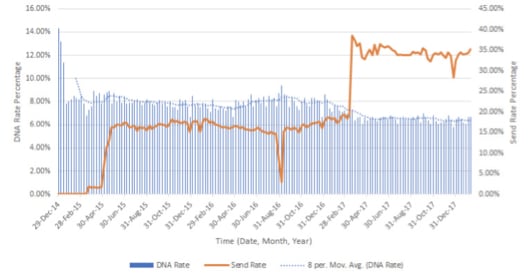
Figure 1. NUH's DNA rate for Diagnostic Imaging before DrDoctor. Figure 1 shows the Trust wide DNA rate for NUH compared to the send rate of messages to patients from DrDoctor. Send rate and DNA rate appear to be inversely proportional, with the DNA rate decreasing as the send rate increases. This can be seen as the send rate increased and DNA rate dropped further when the consent model change took place in March 2017.
Solution
DrDoctor worked with NUH to implement our Assessments module, giving patients the choice to fill out questionnaires digitally. These forms can then be reviewed by the clinician who will advise whether a face-to-face follow-up is necessary.
The solution has been built to help reduce unnecessary follow-up appointments without increasing clinical risk or reducing patient experience. Our aim is that clinics will run with fewer delays and will facilitate better use of clinician time without compromising on patient safety.
The project started with a pilot implementation in Oncology, with the intention to roll out the solution in Breast and Trauma & Orthopaedics. Once the desired pilot results are achieved, it is planned that digital assessments will be rolled out Trust wide and to hospitals across the East Midlands.
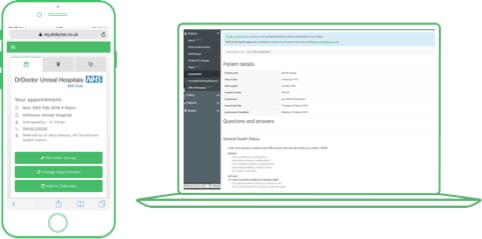
Figure 2. Screenshots of the solution for reducing follow-up activity. Examples of the patient portal (left), where patients can fill out pre-clinic surveys remotely, removing the need for them to be in-clinic for this part of their care journey. And the staff portal (right) where hospital staff can access patient assessment results and make more informed decisions about a patient’s care remotely and in a timely manner.