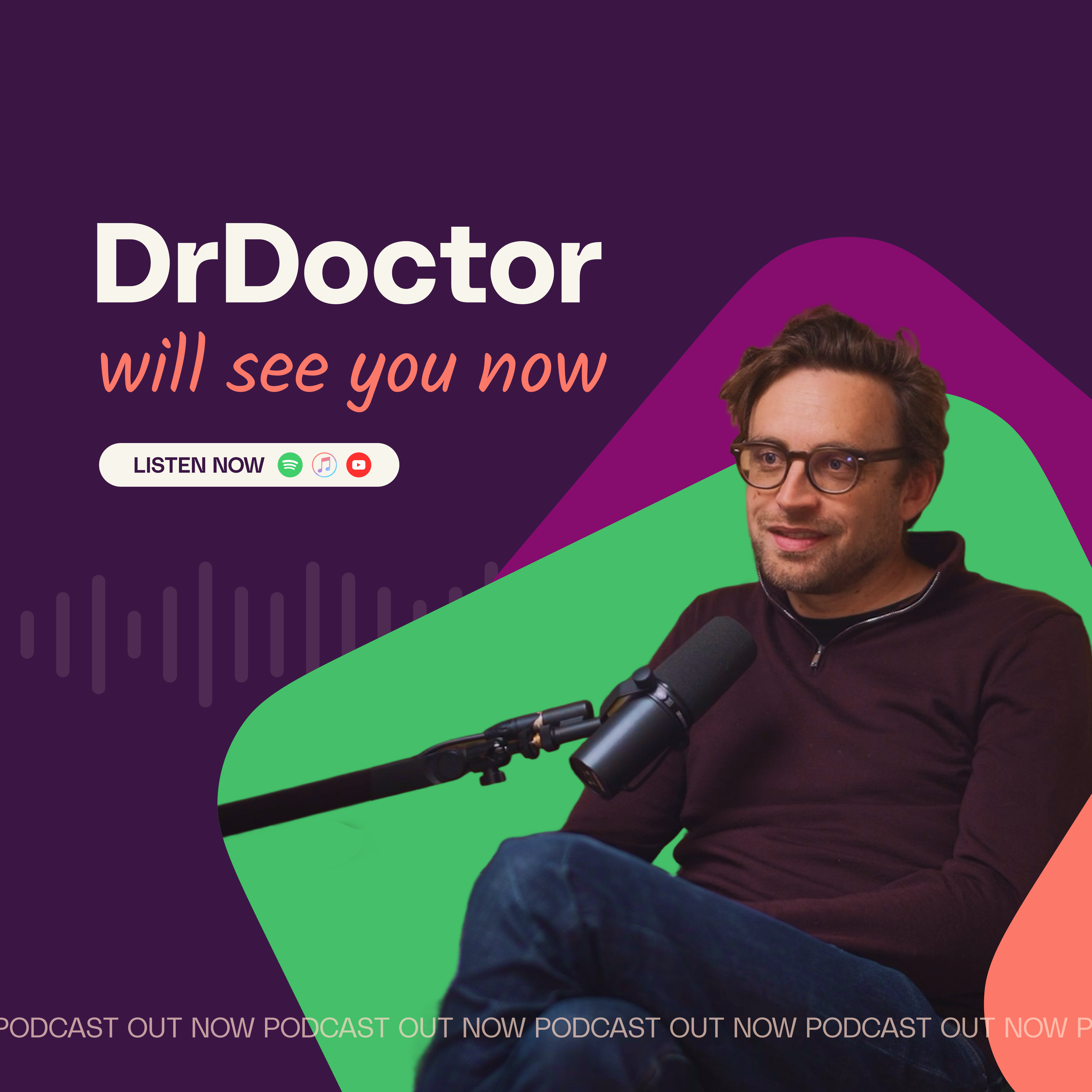
Professor Ian Abbs, former CEO of Guy's and St Thomas', on leading one of England's largest trusts and why the NHS underestimates the risk of doing nothing.
PODCAST - THE DRDOCTOR WILL SEE YOU NOW
The Safest Word in Healthcare is No - and For the NHS, That's the Problem
It connects you to Spotify, which may set its own cookies.
What was covered?
-
The CMO-to-CEO shift: The biggest adjustment was moving from co-accountability to full accountability across every domain - clinical, operational, financial. In a 25,000-person organisation, a CEO never delivers anything alone.
-
The inverted triangle leadership model: Rather than a traditional hierarchy where the CEO at the tip directs downward, it should be flipped - with the executive layer existing to support frontline workers upward.
-
Risk asymmetry in the NHS: There is a structural bias in NHS decision-making: the risk of action is scrutinised heavily, while the risk of inaction is routinely dismissed. This creates slow decisions, diluted interventions, and a culture where "no" is always the easiest - and safest-feeling - answer.
-
Total value vs. cash ROI: The NHS has a tendency to evaluate innovation purely on cashable ROI - missing the full value chain including staff time, patient experience, and downstream system effects.
-
The zero tariff paradox: DrDoctor was included in the NHS zero tariff innovation programme - meaning organisations could access it at no upfront cost. Almost none did. This illustrates that financial cost is not the primary barrier to adoption.
-
Britain's innovation scaling problem: The UK is world-class at invention but poor at scaling. The NHS must become a better first adopter, and government must create conditions where health tech companies can start, grow, and stay in Britain.
Transcript
Tom: I think we're both really a bit obsessive about the people part of computing. I think that's where our interests have always aligned. I'm really interested to explore the CMO to CEO transition. And then perhaps we can talk a little bit about some of the digital themes. So for people that are listening that are clinicians, that maybe being a clinical director, they're in a senior clinical leadership role - what's the shift like from that to being a CEO?
Ian: So I went, let's think from 2011 to 2018, 19, as the CMO, working with a fantastic team, including a very close colleague of mine. Amanda Pritchard was the chief operating officer and then appointed into a CEO role, I think in about 2018. And Amanda went to NHS England and I was asked then to become the CEO. The differences, I think - and I certainly felt some differences - I think the first difference was understanding how to work well and through other people in all of the domains of accountability of a chief executive who was the accountable officer. Because whereas I was the CMO of a unitary board, and therefore I was co-accountable with others for clinical quality, for operational performance and financial stability, the statutory duties are effectively executed through others. When you're the CEO, you are accountable for all of those things, and the buck stops with you. And sort of understanding how to take those accountabilities, but recognise that their delivery was very much dependent on the brilliance, really, of the people around me. And I've been very fortunate to work with the most brilliant people in clinical management, in clinical delivery, in operational management and in financial management. I was very fortunate when I became CEO to be working with those brilliant people. And I recognised absolutely that I was never going to have the same degree of expertise in those domains as they had, but I could work with them to get the best of them to deliver the best that we could as an organisation and therefore that I could do as a CEO. So that was quite an early realisation. I think I'd had that realisation ever since I'd really been in management, recognising that most of the time, in any sort of leadership position, you very seldom deliver anything yourself. You're only as good as your team.
Ian: And how do you both attract the right talent into your team? How do you then develop them? How do you give them autonomy and support in the right mixture to get the best from them? And then how importantly, do you retain them? And actually, also importantly, how do you let them go on to a new role?
Tom: Yes, which is always.
Ian: So I had learned some of those lessons over time. I think they actually, that sort of what you might describe as probably something like a 15 year apprenticeship did help me I think by the time I got to be the CEO. Because, as you said earlier Tom, that's a big organisation.
Tom: Right. It's 15,000 people.
Ian: So now, in terms of the number of colleagues, it's 25,000 colleagues. 3.2 billion pound turnover. And something like three and a half to 4 million significant patient contacts a year. So by English standards, it's a big organisation. And you can only, I think, deliver great care to patients, you know, every day, each hour of the day, every day of the week, through those 25,000 brilliant colleagues. And so I think a lot of being - my view, a lot of being the CEO, particularly in what you might refer to as more of a leadership role - is to enable those colleagues to do the best job that they can. And I strongly believe in what I might describe as sort of the inverted triangle leadership model. So rather than what you might think of as an organisation as being a triangle with a broad base and a very narrow tip, and the CEO sits at the tip and sort of tells people what to do through the organisation, that doesn't work.
Tom: No, absolutely.
Ian: All organisations, particularly healthcare organisations, are relationship organisations. But actually, what my view of an organisation is, in fact, to invert it - and the base of the apex of the triangle is there to support upwards - it's really to support the layers, in fact, above you where and ultimately to get to the long axis of the triangle, which is really where your frontline workers are. And it's your frontline colleagues who are really making a difference to people every day, supported by other parts of the organisation. I would think of sort of leadership, certainly of complex, large relationship based organisations as - one of certainly you have to have a vision, you have to be able to articulate where you want the organisation to go. I think that is a leadership role - to enthuse people with the purpose of getting there. And I strongly, I certainly believe in purpose to articulate and imbue the values of an organisation because it ultimately values that connect large, complex organisations together. But then to give people the freedoms, the autonomy and allow them to be of value and feel valued to deliver the best outcome for the people you're responsible for.
Ian: That's my article. And I think I was fortunate, really, both by the people I work with and by the experiences that I had, that I sort of had those things instilled in me over time.
Ian: One thing I did do, which I don't think is absolutely necessary, but certainly helped me, was quite later on I did do some formal management - I did an MBA, which was useful mainly actually for some of the content, but in particularly for working for some time with people who come from different industries. One of the things I think perhaps we're less good at - we're pretty good on comparison in healthcare, both nationally and internationally between different healthcare organisations. And this might be relevant when we come on to talk about digital change Tom - if you start thinking about what's different between another industry, but actually what's very similar in another industry between what they're trying to achieve there, and what we're trying to achieve in healthcare, I'd argue there are more similarities with other industries and there are differences.
Tom: Yeah, I mean, I would agree with that. And I think people sometimes who've only ever worked in health think of it as, you know, special. And certainly my observation is that the change in management, the people skills, the continuous improvement - they actually copy very well across industries, and we can learn a lot. I think one of the things that does make running a hospital particularly difficult is - my mind boggles at the thought of 25,000 colleagues. But you also have this particular thing, which is some of those colleagues are quite transient, either they're foundation doctors and they're moving around, or they're in job roles which tend to have a higher level of turnover. But then a ridiculously high percentage of them have PhDs, have deep specialism - as we discussed, they're fantastic at ploughing their field, have very strong opinions. And in a lot of organisations you don't have that - you don't have a team of people with PhDs running the checkouts in a supermarket. And I do think that means that the relationship part that you mentioned, and the ability to deploy soft influence, but know also when to sort of set hard lines, is a particular skill that I've seen in top management positions in health that doesn't exist in other industries in the same way. You can't be directive, like you can be in some other organisations.
Ian: Yeah, I think that's right. I mean, I think we are fortunate in this country to have very creative people, highly qualified colleagues working in healthcare in all different types of profession and specialties. So it is truly a sort of multi-professional, multi-specialty organisation nowadays. I think sometimes we must always guard against the sense that knowledge is held at the centre and instruction is then distributed peripherally. I think that is a big mistake in an organisation. Because often, knowledge is held peripherally - we need to find ways of valuing that knowledge and allowing the creativity of colleagues to be exercised, while understanding that sometimes we need to hold on to or let go of risk.
Ian: And one of the things - it's probably a conversation that I need to sort of think through and evolve Tom - but risk holding, risk appetite, risk symmetry or risk asymmetry is a conversation that is not, in my experience at least, commonly had. But a lot of - if we come on to kind of decision making at one stage - I think a lot of decision making is influenced by different elements of the risk equation.
Ian: But certainly that the fact that we have those highly talented colleagues at the front line - and one of the advantages, I think, in some ways of the directorate and service models are that those units at the front line are autonomous and accountable - they're semi-autonomous, but they are semi-accountable. But they do have decision making rights. And in my view, the closer to the front line that you can put decision making and resource and other types of accountability, the better the decisions that are made. But that does require what you might describe as sort of constant gardening between the central and the distal parts of organizations. And it does require conscious effort to make sure that you don't draw too many decisions centrally. But at the same time, you don't allow colleagues to feel unsupported in more distantly. It takes more effort to run an organization that way, but absolutely, the results are better.
Tom: I'm really fascinated by the risk reward balance thing, because I think it's something which the NHS doesn't always get right. And I think we always under index on the risk of doing nothing. And that's the easy decision to make, right - is to do nothing. And within an organization, actually, often, particularly in a world like we live in today - and I'm excited to explore some of the future stuff with you later - doing nothing is the most dangerous course, actually.
Ian: I couldn't agree more Tom. And I think it is a discussion that we have to have. It's not unique to the health system in England. And I think you could have a similar conversation globally. But I think, you know, within the context that we operate in, that there is an asymmetry in the way that we weigh risk. And I certainly strongly agree with you that there is a sense that the risk of action, which is weighed very, very heavily on in decision making about a number of actions that organizations might take, including the sort of digital - which I'm sure we'll come on to - versus the risk of the status quo, i.e. inaction, which is, in my view, never weighed as heavily or examined as much as the risk of the action part of an equation. I think because of that, decisions tend to be quite slow.
Tom: Yes.
Ian: They often ask for unreasonable modification of the action set.
Tom: Yeah.
Ian: They ask for modification or...
Tom: The thing gets diluted down and mitigated.
Ian: Significant numbers of risk mitigation actions, which dilute returns. But, you know, put straightforwardly Tom - healthcare organizations are risky, but the safest word in a healthcare organisation is often no. Because if you don't do anything, then you're not taking a risk.
Tom: And anyone can say no. That's the other thing I always find interesting - is almost anyone can veto, you know, and it's very hard for any individual to say yes.
Ian: Yeah. And that does bear some examination and some probably some academic work at some stage about risk and the words yes and no in organizations. Whereas actually the risk of the status quo tend to be underweighted or, frankly, dismissed. Because if you take - which I'm sure we'll come on to - risks within wait lists, waiting for all the reasons that people would understand, it is not a benign state.
Tom: No, absolutely.
Ian: And it has a number of risks, some of which are significant. You know, I think we always need to ask stark conversations about what is the risk of the status quo? What risks are we actually holding? Which sometimes is a difficult conversation, because it means you have to face into the reality of the current situation, which is not perfect for lots of different reasons. But it's not perfect. But it means you have to articulate them, which means you have to surface them. And you therefore have to take responsibility for them versus the risk of action. But I definitely think that that risk equation is a significant factor in the ability of organizations to act or not act in certain situations.
Tom: Definitely. And I think that point about people looking for perfect is well made too. So I'm going to talk about an example of that, which we both lived through. So DrDoctor at Guy's and St. Thomas. So DrDoctor started in 2012. You know, I was a naive engineer with a twinkle in his eye that we could use technology to help patients. And we've done various bits of work up and down the NHS over the first few years of our lifetime. And we've done a bit of a pilot at Guy's and St. Thomas. We've done a pilot in women's services that had been really successful and we'd built some evidence. And that's when I met you Ian. And we had some compelling data stories to tell about the effect that we were having on attendance rates. But we frankly were struggling to get traction, not just at Guy's and St. Thomas actually, but sort of across our install base. We had quite a few different pilots going and a few organizations like Nottingham had taken a bit of a risk on us, but we were pretty new and pretty unproven. And Ian, I think you lived that point about risk and reward and you took a bit of a risk on the DrDoctor product in 2016 as an organization. Just tell us a little bit about that.
Ian: And again, sort of by around 2015-16, which was sort of post the 2008 financial crisis and therefore coming to what was a period of relatively flat resource investment in the NHS. And actually, if you look back to the - although we talk a lot about waiting lists in the post COVID-19 pandemic context - in fact, waiting lists were growing and people waiting longer for care and the effective and efficient use of resources was possibly less good through that period of sort of 2014-15-16, which is when we kind of first met. There was a period of increasing risk in the delivery of services. And one of those risks was, and still remains, how do you ensure that those resources that you do have are used as effectively and as efficiently as possible? And certainly the evidence that you and colleagues showed at the time Tom, demonstrated that we did have a particular efficiency and effectiveness gain to be made if we did something. But the question was, could we get it more broadly rolled out across the organisation rather than one service?
Ian: The thing that blights, I think, the ability for companies - many of which are highly creative in this country, as DrDoctor is - is the sense that, well, yes, you've demonstrated a use case in service A, now could you demonstrate the use case in service B, C, D and E, and preferably in another hospital in A, B, C, D and E again, before we'll actually put it in? And let's be straightforward, buy it as a service and allow the company to grow. That is a defect of the way that we operate. We might come on to innovation more generally at some stage.
Ian: So we had a choice at the time, which was, look, we can go on asking for more evidence of the same effect, or we can take a risk-based decision, balancing the risk of the status quo, which was that we knew we had less effective and less efficient services than we could have. Let's try and scale this. We had discussions at the time, you know, about a number of issues, including data integration, which is always something that bedevils organisations. Integration, information governance. And, you know, this is back in the days when - I look at people starting digital health businesses now - the original incarnation of DrDoctor lived on a physical server within the N3 network. There was no cloud hosting, you know, and the first data integration we did at Guy's and St. Thomas was with the help of a crystal report - it was a manual extract, which you wouldn't accept these days, but it was the only way to get data flowing to start with.
Ian: That problem of data integration, information governance, how to interpret the results and straightforwardly looking for a resource to purchase - actually, what was, I think, useful at the time was that we did manage to work, I think, very much in partnership. I think there was a strong sense of purpose in colleagues in DrDoctor. Relationships do matter. And developing relationships with organisations and colleagues with common purpose, because, you know, we want to make things better for patients and clinicians. And then I think actually, quite a sophisticated conversation at the time around, you know, where was the value?
Ian: The other thing I think sometimes is we tend to - this is not just an issue of NHS procurement - we tend, understandably, to be focused on things like cash value, cash in, cash out, return on investment types of things measured in cash terms. We're less good on articulating a total value of a value chain, what the current resource utilisation of a value chain is, what the future resource utilisation of a value chain would be in the change date, and therefore, what is the true value of an intervention, rather than its rather crude cash equivalence. And I think for reasons partly because it's easy to measure, we tend to be over focused on cash in cash out and ROI. And we should be more focused on total value. But it's a harder thing to measure. Where we often discount value is in the value expenditure of the people we're serving.
Tom: Yes, quite - that's virtually never calculated in an ROI equation. And actually, one of the things I did find useful talking to other industries as part of that MBA, one of the things I did come back with is around conversations around total value, rather than point value. And that, again, probably another conversation to have at some stage. Certainly, we've discovered that the only way to get sustainable change in hospitals is to break the value chain into slices and say, right, well, here's your cashable - your cashable is going to pay for the implementation and the licence fees. And we can't - you're not gonna have an argument about that, we're all going to really agree that this is - and then we layer on top the harder to cash, but still very clear efficiency benefits. I always find it fascinating that when we talk to CFOs, they say, oh, we know you've seen more patients, but you know, that's not worth anything to me. Your organisation is doing more. When I used to consult in FMCG consumer goods, you know, if you made more widgets, you were more efficient. Even if you were sales constrained, it was still worth something. And then those kind of soft citizen benefits on top. So we sort of layer it up now. But it does, as you say, it's a sophisticated business case and an argument to make with a large organisation.
Ian: And I completely understand it. From often purchasing managers or CFOs perspectives, you know, they're looking, essentially there are any positions and I completely understand that. But I think, ultimately, we need to be having more sophisticated conversations.
Ian: But that did go in, in 2015. And I think it was a great success. And I think we were able, a few years later, to stand on the stage together and say, look, these are the positive results. And I think, you know, the thing that gets forgotten in this story is what Guy's and St Thomas did in those years was pretty much first of its time, you know - to be putting patient engagement on the internet, to be giving some choice around booking, you know, the dental service, and scaled choice booking, patient led booking in a fully automated way during those years. Still don't know many other organisations that have done that.
Tom: And actually, we laid the groundwork for what's become national policy. You know, what is now national policy around patient engagement and the NHS app and all of these things. It was all laid 2015, 2016, 2017, at Guy's and St Thomas. So there was market making going on - proper innovation that's led to national scale.
Ian: Yeah, what was interesting though, at the time Tom - and I still reflect with interest, and we may talk later about the issues of innovation, adoption, and spread more generally - but I'm pretty sure that based on some of the early evidence at Guy's and St Thomas's, for the effectiveness of the DrDoctor software, and backed up by experience at other centres across the country, wasn't there an inclusion of DrDoctor in the zero tariff innovation?
Tom: Yeah. So this was a good initiative in the NHS, which was essentially to zero tariff products to accelerate innovation. And so effectively, organisations could have picked up the product DrDoctor for nothing in terms of tariff, in terms of upfront costs. Yes, exactly, with the ITP. But actually, how many organisations managed to execute DrDoctor on the basis of not having to pay for it?
Ian: Almost none. Yeah, almost. And that tells us quite a lot, I think, about some of the problems of innovation, some of which we've already covered - possibly in the risk equation. Some of it is in the barriers to implementation, for example, data integration, IT governance, capability, and importantly, capacity within teams.
Ian: But it's an interesting - even where you have an innovation of proven benefit that is not being charged for, it is still seen as a real or perceived cost of some type, that prevents organisations executing, which I think is interesting. And it does lead us to a conversation around, you know, having learned that lesson, what do we have to do to adopt and scale innovations in practice, which may be process or clinical, but importantly, which is a broader point which I've now gone on to think much more around - is how do we create conditions where creative companies can start in this country, because we have no lack in this country of creativity.
Tom: And entrepreneurs.
Ian: We have no lack of, in our entrepreneurial colleagues in our universities, of creativity and invention. But we don't have a good track record then of scaling. And so we need companies. And this is where I think the government is absolutely committed to creating environments where companies can start, importantly, stay in this country, rather than having to do the trip to the States, and grow. Because a company - look, let's just be honest - if companies can't grow, then they cannot be sustainable. And so we have to create those conditions, ultimately, to create an economy that's driven by the sorts of technological invention that you've demonstrated Tom.
Ian: So I think there's the broader questions, even beyond healthcare, of how we - because I don't think healthcare is alone, perhaps, in having an issue to solve when it comes to the ability to adopt an innovation.
Tom: No, not at all.
Want to lend your voice?
We are on the lookout for industry leaders to join our podcast, so if you want to be part of the incredible conversations we are having around digital transformation within the NHS, we would love to host you on DrDoctor Will See You Now!