The NHS already lost this argument once
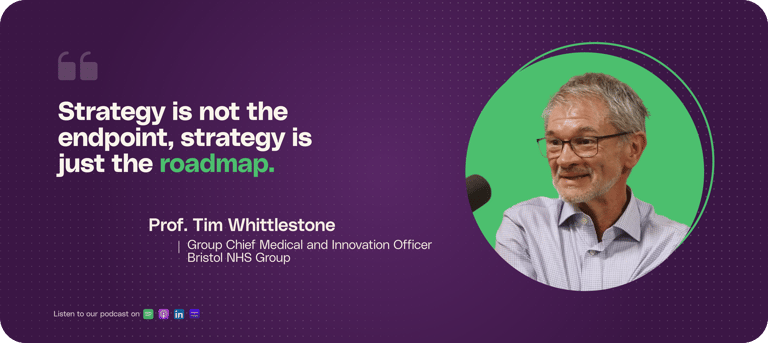
A former warehouse that used to sell toilet rolls is now a seven-day-a-week diagnostic centre offering everything from X-rays to endoscopy. That's not a pilot scheme. It's already running in a Bristol shopping centre, and it's the clearest example of where Professor Tim Whittlestone, a surgeon and systems thinker currently writing the 10-year strategy for Bristol's NHS trust, thinks outpatient care is headed.
Whittlestone shared what healthcare in Bristol, and the wider NHS, could look like by 2037. His answer isn't about new hospital buildings. It's about taking diagnostics and follow-up out of hospital sites altogether and putting them as close to patients as the high street.
Here's what that means in practice, and what it tells NHS leaders, innovators and suppliers about where outpatient care is heading.
Why is the NHS moving care out of hospital buildings?
Because most of what happens on a hospital site doesn't need to happen there. Whittlestone's strategy for Bristol, covering 2027 to 2037, is built around a simple test: if a step in the patient journey doesn't add value, take it out of the hospital and put it as close to the patient as possible.
That doesn't mean sending clinicians to people's front doors. Bristol's own patient research found the opposite: patients don't necessarily want a knock at the door. What they want is something in between home and a "shiny building", as Whittlestone puts it, several of which are over 100 years old and no longer fit for how care is delivered now.
What does high street diagnostics actually look like?
It looks like a converted warehouse. Bristol's trust already runs a diagnostic centre in Cribbs Causeway Regional Shopping Centre, a former retail unit that now offers everything from plain X-ray to endoscopy, seven days a week. Whittlestone describes it as well liked by patients, easy to reach and running at full pace.
The next step, in his view, is pushing diagnostics further out again, onto the high street itself. He tells the story of his daughter losing an afternoon of school to sit for two hours for a routine blood test, then asking him afterwards why it couldn't have been done in a chemist. He didn't have a good answer. "Maybe you should be able to have it done in a high street chemist," he said. The same logic applies to wearable and sweat-based diagnostics: results that reach a clinician, or an algorithm, at any hour, rather than requiring a hospital appointment to generate them.
Are GLP-1 weight-loss drugs actually a game changer for the NHS?
The evidence is starting to say yes, and Whittlestone is unusually candid about arriving at that view reluctantly. He describes walking into meetings on GLP-1 drugs "with a cloak of cynicism", wanting hard evidence rather than hype. What's changed his mind is US insurance data, where insurers hold complete records of claims, diagnoses and outcomes across the population they cover. That data is starting to show people whose metabolic health improves through medication seeing less addiction, fewer mental health crises, and reduced progression of some cancers.
The problem, as he sees it, is access. Getting GLP-1 drugs on the NHS currently requires proving BMI and ill health to a degree he calls "reverse means tested". Anyone able to pay privately can access them easily; anyone who can't has to prove they're sick enough first. His strategy response is to push toward oral, off-patent alternatives and looser prescribing guidelines, treating this as an equity problem to solve quickly rather than a cost problem to manage slowly.
How is genomics changing what screening can do?
Screening is shifting from finding disease early to preventing it happening at all. Whittlestone points to genomics and proteomics, understanding which proteins a person's genetic code produces and why some of them stop working as expected, as the next frontier after early detection. The work so far is concentrated in rare diseases, where the UK has strong research depth, but he expects it to extend into cancer and chronic disease as AI accelerates pattern recognition across genetic data.
What we're now lacking in that space is just the creativity. It's knowing what to ask the machine to go and look for.
Does screening reduce health inequality, or make it worse?
Done well, it can reverse it. Bristol's lung cancer screening programme is Whittlestone's clearest example. Ten years ago, a patient diagnosed with lung cancer in a wealthy part of Bristol had roughly double the survival odds of someone from a lower-income area. By targeting screening at the populations with the greatest need first, that gap has not just closed, it has flipped: outcomes for the lowest-income group are now slightly better than average. It's a result he describes as needing further explanation, but one that makes the case for deliberately weighting screening access toward the patients who stand to benefit most.
Why clinicians push back on outpatient transformation, and what changes their mind
Whittlestone doesn't dress up the resistance. He recalls a room of clinicians telling him bluntly that his ambition to cut outpatient follow-up by 30 to 60% "isn't going to work".
Underneath the scepticism sits a more personal question: what does this mean for me? Will I still work the same days, in the same place, after ten years of the same routine?
What shifts that view isn't a better slide deck. It's showing people the alternatives directly and demonstrating that patients are willing to use them. Understanding follows demonstration, not the other way round.
The three shifts Whittlestone is building into Bristol's strategy
- Genomics and proteomics, moving from rare disease into cancer and chronic disease
- Metabolic health, principally GLP-1 drugs, changing demand for diabetes, obesity and some cancer pathways
- AI as a diagnostic, education and screening tool, spotting patterns in data faster than clinicians can manually
He's clear that reducing demand in these areas isn't the whole picture. An ageing population served well by better metabolic and genomic care will need more end-of-life and frailty support in turn. The strategy has to account for both sides of that shift, not just the savings.
What DrDoctor takes from this conversation
Whittlestone's argument lines up with what we see across the trusts we work with: the constraint on outpatient transformation is rarely the technology itself. It's building the case, department by department, clinician by clinician, that a different way of working is safe, workable and better for patients than the routine they already trust. That's the culture work behind every outpatient reduction target, and it's slower and more human than any strategy document suggests.
This piece draws on a conversation with Professor Tim Whittlestone, surgeon and strategy lead at Bristol's NHS trust, recorded for the DrDoctor Will See You Now podcast. Listen to the full episode for more, including his quickfire answers on robots versus surgeons, the NHS policy he'd abolish tomorrow, and what he'd do with £10million.