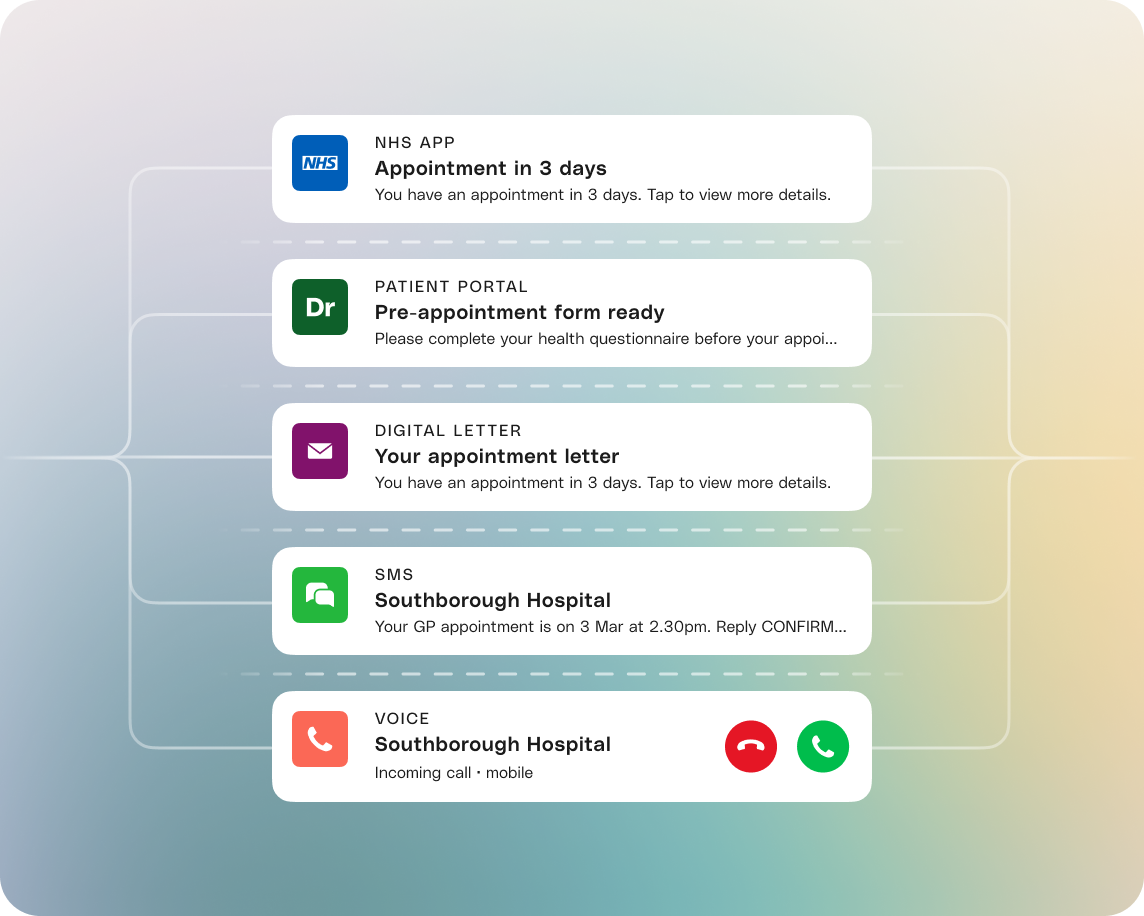
Tom: Let's talk a bit about that family and they go home. So I think this is where it gets really interesting. We assume now that patients are going to go home and they're going to Google what we discussed. We'd be amazed if people don't. And increasingly, they can talk to a chatbot and it can give them pretty good advice. How do we provide the tools to give them continuous care when they're at home, whether it's through voice or other things? Because that does feel like where we're headed with this, right? What's the patient assistant in this journey?
Umang: Yeah, and I think that goes to the other point again. I want people to be sat there in clinic going, "Oh, I can use Lovable to create the solution for you specifically. Here's my tracker." Rather than going through the journey being like, what's the generic thing we're sort of saying, do this, do that, versus going, well, actually, in the moment for you, it's this. That is the joy of caring for someone, versus just, I don't know, being in pharma and making a drug for everybody. There's something about the actual caring bit that's personalised and needs to happen. So I think there's something around giving people the tooling to do that there in the moment. And then, you're right, they become personal assistants. You've got to let them go. AVTs may be a bit for us, to help us feel a bit better. The next stage is absolutely how do I help you feel better, because that's ultimately what we're all trying to do. And we get a buzz from that as care providers, as much as hopefully the person that feels better gets from it too.
Tom: That world needs some form of governance, though. I think we need to really carefully watch it.
Umang: The two things I really think about are, one, we can't let stuff just be done to us, and then the cat's out of the bag, right? You could say, well, people are Googling it, and then we're like, "Oh, but we told you not to Google it." We sort of saw that with social media a bit. We were like, "Oh, we don't like social media," when actually maybe we should have leant in earlier. Even though we're too old now, maybe we needed to force ourselves to use Snapchat and work through some of the challenges, or at least be part of the conversation and listen to people that use it more. So one is making sure we don't let something happen the way TikTok became a use case for news. We can probably step in on that in our world, or at least we've got to try. The second part is having platforms with the ability to say, "Look, we're going to orchestrate this stuff for you. We're going to let you do some things, and we're going to handle the rest, the really boring stuff like security, where the data's stored, the audits, all the stuff the average clinician isn't going to need to know about." Going back to the coding point, you can create a little product, but it won't stand up if you try and run it for more than two concurrent users. Let us deal with that at an orchestration level, and then you've got the infrastructure or the platform you can build on top of.
Tom: The orchestration, I think, is really fascinating. For years, the evidence has shown that the more engaged a patient is in their care, the better outcomes they get. There are all these frameworks about trying to get people to come into a consultation room prepped so they have a valuable conversation. And I think that's what these tools do. But sometimes I think they're viewed with skepticism. Your point about social media is interesting, in that I think we all regret not leaning in harder. I strongly don't believe in prohibition, because it's never been shown to work anywhere. But I also think the complete lack of regulation we allowed in the social media space has obviously turned out to be a bad thing. Getting the balance between regulation internally and externally, so these tools can be used really safely, is interesting. We even worry, within our own relatively small business, that the ability for almost anyone to generate features is really dangerous, because you get all these heads running in different directions and no product coherence. And if you're a CIO of a hospital, the thought of anyone being able to make an app is quite scary. So putting an orchestration harness on top of that feels really important.
I met a lady in America earlier this year who told me how, in America, the biggest challenge is that all the providers aren't very well joined up, so it's actually just managing the administration around your own care that's hard. She was using ChatGPT to do that. It wasn't diagnosing, it was just, she put everything in there and it told her, this is what's happened and this is what's going to happen next. It organises her life for her. I'm really interested in that. I love the idea of taking DrDoctor from where it is today, which is about facilitating better access and being an intercommunication interface between the hospital, the clinician and the patient, and really leaning into being a patient-facing orchestration layer. So as a patient, you have something on your phone which helps you know exactly where you're going next in the journey, and provides an interface directly into your care team. But it solves the problem, which has always been a big one, that if you allowed open access to patients, it's too much work for the doctors, because the agents are in the middle. I love the abundance concept: being able to reach out to as many patients as you want, as regularly as you like, and give them a route back in that's safe, well-regulated and caring. It's a pretty utopian thought, but it's not that far away.
Umang: Well, like progressive abundance, right, versus me thinking, how can I limit it? From my own practice, I remember the first time I started giving my email out in clinic. All my colleagues were like, "You can't do that, what happens if everyone emails you?" And you're like, well, okay. It turns out no one really emails you. But there comes a point where it's not that useful a thing either, it's a bit of a token gesture, because you're still expecting them to email you back. The people who need to email you don't, and the people who don't need to don't either. So I definitely think there's something in it. And doctor to doctor, I'm super well placed to say, you have to solve that problem. It has to be in the patient's hands. We can't have it both ways: we do not want a paternalistic healthcare model that just says, "I'm the lead clinician and you do what I say." We've definitely progressed beyond that. We've moved 20 or 30 years past that sort of Lancelot Spratt model of healthcare.
Now what we need to do is start going, okay, now that you've got it, how do we get you to do it in an abundant sense? Some of that abundance is information. How is it so bad that I still relatively regularly get people who don't know they can give their children paracetamol and ibuprofen on the same day for a temperature? How are we not able to get decent information around that? We've got to solve that. I think being able to communicate matters, and I'm sure if you had a video of every consultation that family had had, somebody would have mentioned it, but they hadn't understood it. So just saying it alone isn't the solution. We've got to work out ways of delivering that message multimodally. Language is a big part of it. I was challenged the other day when I was showing somebody a large language model: why can't we turn this into a story about Winnie the Pooh that somebody can read to their kids? And they said, okay, great, but why is it still just words? Why isn't it creating the TikTok video, the extra bit? And why isn't that thing being controlled by somebody I've already given all my trust to, my doctor? If that's the case, we have to put the right pressure on doctors to say, "By the way, we're letting you drive the truck, don't drive it into a river. If you're worried it's distracting you, come over here and we'll help you with the training." I think that's incumbent on us: we're going to help you. Because there's zero way patients look at this and think, "I'm going to trust the Epic system, or the Oracle system, or the Windows system." That's not it. It's, "I'm scared."
Tom: And I trust you.
Umang: "Please help me."
Tom: Yeah, I absolutely love that: you're my doctor, we have the relationship, help me do this, and then surround me with all the tools I need to make a success of it. I love the idea of the TikTok video. The language thing is something I've found so compelling over the last six months. As you know, we've built some AI voice tools that reach out to patients, and patients can phone into. Unbelievable traction for that product, from hospitals but also from patients. Both sets of people absolutely love it. One of the big things has been the multi-language capabilities. Whether it's a hospital in London we were talking to recently, where, if you look at the cohort of people not coming to their appointments, often they're non-native English speakers. It was really interesting, your point about being worried about filling out the form, not because you're scared of the form, but because your dad was worried about his English. Being able to speak to something that talks your language is just absolutely huge.
We did a piece of work with a partner of ours in Leeds around health checks. They were really struggling to get people in for certain cancer health checks from certain demographics. The way they solved that was by hiring people from the local community to make outreach phone calls in their own language. It totally transformed the uptake, and it was a great piece of work, we're very proud of that. But it doesn't scale very well. Now we can scale it.
(The next section is fast, half-improvised back-and-forth. Attribution is a best guess.)
Umang: Now we can phone people up and speak to them in their own language, for as long as they want, that's the other thing, it's not rushed. And to your point about context, you can add context in, right? Before, it was like, okay, maybe I can just change the words. But do you have 14 minutes to explain clinical trials, for example? That's much easier for me if you come and see me in my setting.
Tom: Oh no, not enough people want to do that.
Umang: I know, I'll come and see you in your setting.
Tom: Again, I don't really like that.
Umang: Okay, well, I'll try and rush it into this instead, but I've got to go through all these things in my language. But again, I didn't have the understanding, even if you gave me the words. So what's the vocab? Being reactive to that is available now.
Umang: Short snippets. We never stop and let people ask questions. We're always just complete, like healthcare is far too broadcast. I've got eight minutes, so I've got to get it all out, I'm going to rush to tell you everything and hope for the best, versus spacing these things out. I think that's what abundance is for me: it's time. I would love an abundance of medications that change physiology, and personalised care, and all the rest. Maybe we thought we were going to get a few steps closer to that before the pandemic. Whereas now I think the abundance is going to come back from time, from caring. It's really sad, the NHS survey that came out, I can't remember the exact stat, but something like just over half of people would recommend coming to work in an NHS hospital. If you don't want to be here, and nobody wants to be a patient there either, how do you change that dynamic and get back into a different culture? I think this is how you do it: go back to caring, take away some of those things, better prepare patients so they feel more comfortable. There's no better job than helping somebody when they need help. It's a brilliant thing.
Tom: Go and do the thing you're trained to do and look after people. It's taking it back to the 16 year olds and what they want to do. That's why they want to be doctors.
Umang: Yeah. It's not because they want to do the paperwork or have only eight minutes, they want to care for people. My niece wants to be a surgeon, it's sort of funny, unfair to name her in this, but there's something about, if you ask anybody as old as us who works in the system, would you recommend it? People say no, sadly true, but probably our body language says yes. Even if we say no, there's something about, "But hey, what amazing people you get to work with, what an amazing ambition you get to find." I'm sure it's the same running DrDoctor. Why do people work for you and not go and work for Facebook? There's something about, what is the thing I really want to be part of? It's a game we're never going to win, but even a little bit of it is definitely worth it.
Tom: I have to admit, as an entrepreneur, it's a real cheat code, because if your business has purpose, you can attract much better people than you deserve to attract, and they hang around much longer. It's a wonderful thing. A bit cheesy, but I wouldn't want to do anything else.
Okay, so we can create abundance, and let people who work in the system do the bit that matters to them and really care. Let's go forward a bit further, because it's always fun to look into the future. We've known each other 14 years now, so let's fast forward another 14. What does the health system look like then? We're sitting here, sort of retired, possibly.
Umang: We're sitting here sort of retired, possibly.
Tom: Yeah, maybe. We'll probably still be kicking around being annoying.
Umang: We will. We'll be going, "Well, I told you."
Tom: I can 100% guarantee that's true.
Umang: It's funny, if you go back to where we thought we'd be now, some things are absolutely amazing. Could you imagine saying the world would generally accept that digital first was a good way to do things? The NHS App: imagine describing this thing with all this demographic usage, all this sign-up, and then betting a million quid it's not made by the NHS. You'd never have believed it could be done, but it has. So, in answer to what I think the future holds: in the pretty short term, every patient will be sent home with a chatbot, not a patient letter. I'd love to see every patient come in with their own large language model that says, "If it's all right by you, I've got this thing that's going to take it away and help me," or distribute that information to family members so we can do more holistic care. What we'll start seeing, my hope, is that in 14 years we'll reach the limits of the software and need to start thinking about what hardware looks like, and then we can properly geek out, do really cool stuff, robots and things like that. But the next decade will be about maximising software.
Tom: That requires you to do things in different ways. Value-based care, you and I both love talking about that. Now that I know all these things, what can I do around the financial modelling that sits behind delivering against value? Again, AI allows us to actually deliver on that promise of value-based care, because so much of the challenge is the complexity of managing the payments and the accountancy in the background, which is way beyond my pay grade.
Okay, so I love that. So in 10 or 15 years' time, we're still kicking around, which I think we should shake on. Everyone's going home with a chatbot, getting the care they need in a value-based way. So what's the role of big tech in that? What's the role of NHS England in that? And what's the role of the startup in that?
Umang: I think it's big tech. I've been working on this analogy for a while: a lot of what we're trying to do is lay track. We've got this stuff happening, and we're laying more track, and people are hopefully getting on the train more, going to different destinations. So I think big tech's job, or any infrastructure provider's, like electricity, is to be one of the infrastructure players laying track or groundworks, whatever analogy you want. Then DH, NHS England, or the government, their job is to work out, when I plan a stop, what do I need to put in and around it? So we'll be big tech going, "Just point somewhere and we'll build a road to it." But where do you want to point to? And when you do, you're going to have to put other services in and around it, so we're going to have to work out what we do. More and more people are self-diagnosing: what does home testing look like for diagnostics, and how do you plug that in? Then I think startups have to be the coffee shops on the platform. That sounds like a trivial use case, but I really don't want it to be. My wife and I both commuted, and the commute isn't the joyful part of the day. The joyful bit was getting to commute in one morning with her, we'd been quite close to each other at Paddington but never at the same time, and she said, "Oh, that's my favourite Starbucks, they know my order." It never occurred to me she had a favourite Starbucks. There's something about how you add something meaningful to something that's a necessity, which healthcare is. That's what I mean by startups being the coffee shops, as opposed to something throwaway. What is the thing that actually gets you there, and what scales from that? Then you need to think about lunch too, maybe, or the easy analogy.
Tom: Okay, great. Now that I know this, what can we do?
Umang: There's something about that. I love the startup as the espresso: it provides the kick to the day, the bit that makes it all worthwhile. And overusing that, going back to where you go with your colleagues outside the office in this new world, you don't book a meeting for that, it's where you have a human connection with colleagues when you're doing hybrid working, in the coffee shop or whatever the equivalent is. That's not trivial, I think in many ways it's potentially the most important part. It's the bit you remember, whereas the rest has to blend into the background.
Tom: Do you know what I really love about this conversation? So much of it has focused, for two people who are basically geeks, on purpose and human connection. Because it does come back to that, doesn't it?
Umang: Yeah. That's where the change happens. That's why we go to work. It's why we try and do the hard stuff.
Tom: What's going to stop that? Not to bring us down before we get to the end, but what keeps you up at night? We've spent 14 years, we know what good looks like. What could derail the train?
Umang: Yeah, sure. I think it's not feeling like we have the ability to put it where we want to. That sovereignty, not necessarily from a geographical standpoint, but we know our patients and we know our stuff. So what derails it is bad signalling. We've got to know what we want: one risk is going too fast, the other is going too slow, and I don't know what the Goldilocks-
Tom: The train's got to be on time, right?
Umang: Exactly, you've got to have consistency. Maybe going back to the core, what's the regular beat, what are we going to drop, accepting it's not going to be every single day? I need Lawrence at MHR and the whole group of them to help make that easy, and give people an understanding of what the pace can be, so we can plan around it. And the final thing: if we think trains are the best way to travel, but we don't do it in a way that works for people, then we force everyone to buy a car.
Tom: Or you have to come up with another way, right? I think then we've missed the opportunity to put in good infrastructure that leads to other downstream consequences. That's the signalling. This too fast, too slow thing is absolutely right, and the risk of either is really high. With COVID, perhaps we went too fast, and at other times we've certainly gone too slow. The other thing I'm really thoughtful about is that the role of those three players, the startup, big tech and NHS England, needs to be known within that ecosystem, because it only works when everybody's playing in tune. I think one of the risks is that NHS England, who perhaps need to own the platforms, or do own them because they own the hospitals, also need to run the timetable well as a regulator and as a commissioner. We talked about the App a bit, and it's a huge success. One of my biggest worries is that NHS England tries to build everything itself, because that would be a disaster when you have such a rich ecosystem of other people providing. Getting the balance between being a commissioner, a regulator and creating a market is almost going to be the difference between success and failure, particularly if the NHS wants to export.
Umang: And we started this conversation talking about how unique the NHS is, and it certainly is.
Tom: I hope the endpoint is that in 15 years' time we've exported this amazing model we've created in NHS England and the UK to other countries, and we're really showing how health systems should be run. What an amazing export for UK PLC, and to the point of sovereignty, to have created the businesses, the IP, the new models, and driven perhaps a golden era of economic growth in healthcare. But I think that will only happen if there's a market of businesses working together to create that within NHS England.
Umang: I think all these chance things, like the discovery of penicillin, are of course based on successful contributing factors that don't quite get into the final cut of the story, but they're all there. You've got to have great science, diversity, a great starter dataset, great universities, a culture that wants to get things done differently, and safety, you hopefully aren't evacuating a hospital while also trying to come up with these discoveries and attract global talent to sit next to them. I think we've done that historically really well, and the world needs more of it. We should put ours into the ring. That's what Europe does have massively, that ability to collaborate. Despite everything else, no one from the academic community has said, "I'm not going to share that with someone else." I think that's really exciting too, and we can definitely model that going forward.
Tom: The UK has a really unique opportunity, doesn't it? I feel really hopeful after this conversation. Everything we set out to do at the beginning feels almost within our grasp. We just need to continue to push and innovate.
I'm going to close with some rapid fire.
Umang: Yeah, okay.
Tom: So I've got some questions for you. What's the best piece of advice you've ever been given?
Umang: The best piece of advice I've ever been given is: if you don't do anything, it'll still end up being bad.
Tom: Nice, okay.
Umang: The context for that was, I was on PICU, intensive care, and I remember being like, well, I don't know if I give fluid or don't give fluid, it could go one way or the other. And the boss came in and said, "Yeah, but if you don't do it, the patient will die." So there's definitely something about, you've got to do something. That's great advice for the NHS too: do something, please don't do nothing, because the default is to do nothing.
Tom: Yeah, absolutely. What's the worst piece of advice you've ever been given?
Umang: Just do what I did.
Tom: Fair enough. What's the NHS in one word?
Umang: Important.
Tom: Nice. AI and healthcare in one word?
Umang: Strong.
Tom: One thing you wish someone had told you before going into healthcare?
Umang: Oh, that you get addicted. You do get addicted, don't you?
Tom: I know. And you'll never drive a Porsche.
Umang: You'll never drive a Porsche. And you'll still be here talking about it in 15 years' time.
Tom: If you could fix one thing about the NHS, no budget constraints, magic wand, what do you fix?
Umang: Culture. Just culture, every day of the week.
Tom: Fair enough. Do you want a story on that?
Umang: So Babylon went wrong, as we all know, and people often ask what went wrong with it. I think we lost our culture. I remember when I first joined, having never joined a startup or a tech company before, I went into Waterstones and looked at all these books on startups, and fundamentally they were all about culture. I read a load of them, and remember thinking, that's a bit of a cheat, that's the easy book to write. Having lived through Babylon, it started to go wrong when we lost our culture. I like that truism that culture eats strategy for breakfast, it's so true. If I had a magic wand, going back to the best of NHS culture and giving that enthusiasm and love back to everybody would by far be the most impactful thing.
Tom: I completely agree with that, culture eats strategy for breakfast. If you could give our illustrious leaders at NHS England one piece of advice on culture, what would it be?
Umang: Listen, just listen more, and to diverse voices. There's a lot of listening, but not a lot of hearing.
Tom: That's great advice, a lot of listening, not a lot of hearing. And in five years' time, more AI or more human?
Umang: I think there'll be much more AI, which will let us be more human.
Tom: I think that's a brilliant note to end on. Thank you so much, I really enjoyed that. I hope you did too.
Umang: I did, yeah, loved it. Let's check back in in 15 years and see if we're right.
Tom: I wonder what anniversary that'll be, I'll have to look it up. Thanks very much.