In this episode, we conclude our conversation with Milica Stjepanovic, Deputy Director of Operations at Imperial College Healthcare NHS Trust, unpacking how the Trust moved from a full to a choice booking model - and what happens when you layer automation on top.
PODCAST - THE DRDOCTOR WILL SEE YOU NOW
1.7 Million Down to 1.2 Million: The Maths Behind Imperial's Booking Revolution
Mentioned in this episode
 Automated Scheduling
What was covered?
- Phased over "big bang": Mel deliberately rejected a single Trust-wide launch, starting with two services, then four, scaling to full coverage by the end of the financial year.
- Building coalition before rollout: Success depended on choosing teams that already wanted the change, backed by strong communications and project management support.
- Culture of continuous improvement: Mistakes are expected and normalised ("you will fail") - frame failure as part of progress, not a reason to stop.
- Listening to clinical pushback: Direct, humble conversations with consultants surfaced the real blocker rather than assuming resistance was the issue.
- The numbers case: Imperial went from 1.7 million to a projected 1.2 million booked appointments a year - by cutting the churn of late cancellations, rebooking and DNAs baked into chronological, long-lead-time booking.
- The London Improvement Network: Imperial is part of a cross-Trust group (Barts, UCL, King's, Chelsea and Westminster and others) sharing and scaling the choice booking approach.
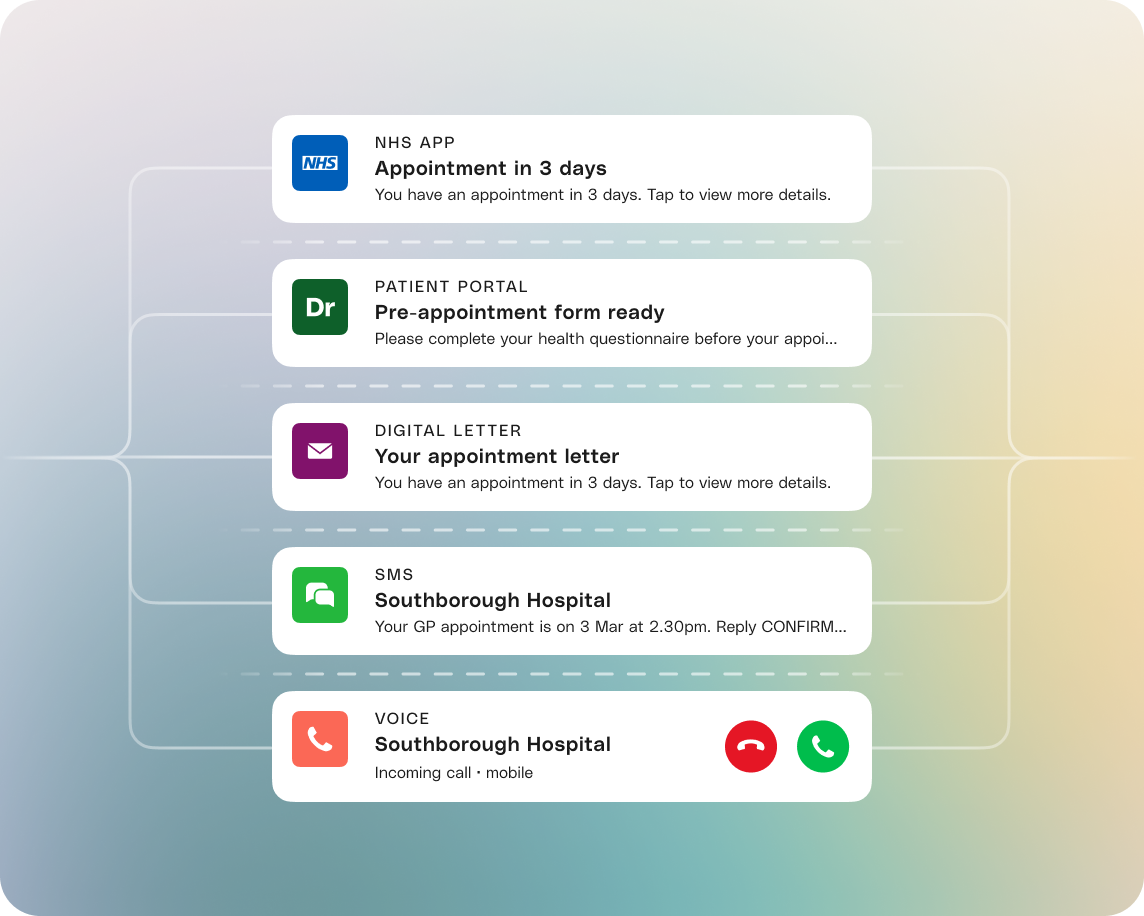
- Automating the short-term cancellation gap: DrDoctor-style text alerts fill late-notice slots automatically - dozens of same-day and near-term slots filled that would otherwise sit empty.
- From SMS to voice automation: Robotic call-backs for non-responders, with agentic voice tools enabling multi-language conversations, extend reach to patients who don't engage with text.
- Redistributing human time, not removing it: Freeing administrators from repetitive dialling so they can spend real time with frequent attenders and people who need extra support.
- Process before technology: "The new toy" won't fix anything on its own. Imperial had text reminders before and they didn't move the dial; the operating model must change first.
- Theatres as the next frontier: The same abundance-of-outreach logic could apply to theatre "come-in" (TCI) calls, though patient anxiety around procedures means human interaction stays essential for now.
Anyone can build an AI that answers a call...
...getting it to read a patient record, respect your booking rules, and write back to your PAS - now that's the hard part. Our voice agents connect directly to the systems your teams already use.
Transcript
Tom: So welcome to another episode of DrDoctor Will See You Now, the podcast where we explore the intersection between technology and operational change in the NHS. And I'm really excited to say today we're going to be talking about a subject which is really close to my heart, which is giving patients choice, control and agency through partial or choice booking of appointments. Now, this is special to me because the very first thing I ever did when I worked in the NHS was help Coventry Hospital move from a full booking to a partial booking process many, many years ago. And so I'm absolutely delighted to have Mel, who's Deputy Director of Operations at Imperial Healthcare NHS Trust - I hope I've got that right - and an expert in patient booking models to come and talk to us about the work they've done. What have you learned about the cultural change? And what can we take forward from that? What works in terms of cultural change?
Mel: I think that the phased approach is definitely the way forward. You know, I don't believe in the big bang. Yeah, I think it's just too much anxiety. And you know, I'm 40 when I was 30, maybe 40 already - I can feel myself getting anxious.
Tom: And it's unnecessary.
Mel: It's unnecessary. And also, it won't work. Not everything is going to work how you have imagined it, okay? It won't. And if you're doing the big bang, it's just unnecessary. So what we did, we did a phased approach. We did only two services, I think we started with. Then we did four. Then we agreed, okay, by the end of the year, we had the number that we wanted to go to, okay. And I was going after that number. And the plan was by the end of the financial year to onboard every, every specialty on it. And then it was easier because first I worked - I created the teams that I knew wanted this to be successful. And I think that's very important at the beginning, specifically when you don't know how it's going to work. There is quite a lot of pressure, all eyes are on you. So the teams that I worked with, they wanted it. So I was like, okay, if they want it, they will not allow me to fail. We will work on it together. And it was that shared ownership. I had quite amazing support from my communications colleague - she was there shoulder to shoulder with me, helping me with any communications that I needed, because I'm not particularly a good communicator - irrespective, I talk a lot, but not, quite a lot of things are in my head and I'm very good at putting everything on paper so that everyone can understand it, and she was very good in helping me with that. I worked with some incredible project managers who made sure that we were on time.
Tom: It's all structured.
Mel: Exactly. And I think those are the very important bits, so that when we went and spoke to our teams, we looked prepared. There was no disconnect between us. It took us a while to get to that point. We started to prepare from October probably, and we rolled it out in July. So it takes time. But I think that was key.
Tom: And I think it's okay for it to take time, because certainly the sort of, you know, iterating on the concept and the communication, but then when you have it really clear, taking it to the organisation is often something we see in a successful rollout. It's, we're going to learn, we're going to learn, we're going to learn - now we know what good looks like, and we go with clarity to the organisation to do the scaling phase.
Mel: Yeah, exactly. Like we work at Imperial under the continuous improvement umbrella. And I believe in it. So if it's continuous improvement, then we all need to believe in that. You do something, you evaluate, you fix your mistakes - they will happen. Don't be so tough on yourself. I always said to my team, just stop being so tough on yourself. You will fail. I failed hundreds of times. I was a diver - I failed more than I succeeded.
Tom: Yeah, it's a part of life. Nobody wakes up in the morning and just becomes this person, you know - it's a never a truer word, right? Always learning, pushing a little bit every day.
Mel: Correct. And be humble. And - I don't look humble, but I was very humble in this project. I wanted to hear the true feedback, what doesn't work. And I was not shy or scared to go and talk to my consultant colleagues and ask them, okay, I hear you, you have some, talk to me, what is it? And that's how we came to the essence of the chronic conditions issue - that's what the problem was. I was like, okay, well, no problem, let's find a way of how we can do it.
Tom: I think that humbleness, willingness to listen, but also being really clear about what does need to happen, is critical.
Mel: It was. I think you can't argue with numbers, okay - 1.7 million, 1.2 million seen - the numbers speak for themselves.
Tom: And the statistics we've seen in terms of how much better the experience is - ultimately we know that when you have chronological booking and people are booked a long way out, they get rescheduled and they are not seen in clinical priority order by the end.
Mel: It's impossible. I mean, I would challenge anybody to come and tell me that they have managed to do it, because, you know, I'm quite determined to try to improve things, and we tried. I think it's impossible because you cannot keep up.
Tom: It's like dominoes - you knock one over and everything falls, and you have to start again, and we see it again and again.
Mel: And it's just, if you think it takes five minutes to book the patient, okay - if you want to call them, if you don't want to call, if you want to call it probably takes a little bit longer - it's impossible to put that many people in an environment where productivity is the number one thing that we are talking about. So I think we need to think differently, and we need to be brave, okay - that errors will happen, mistakes will happen. Understand them, understand why they happened, and don't be scared. I told everybody, just jump. You think you're ready? Jump. And if it doesn't work, well, okay, go back.
Tom: And we'll try again.
Mel: Try again.
Tom: We'll try again - there's the diver speaking. I mean, I think what I'm taking away from this: good executive sponsorship is key, be brave, don't be afraid to fail, be humble and back it up with the data.
Mel: Correct. And if you do those four things, I believe it will work.
Tom: Yeah, exactly. And I think what's really positive about this is if you look at the improvement you've had at Imperial, if you were to scale that up across London and the rest of the NHS, we'd deal with our productivity problem. It would be dealt with.
Mel: Definitely. I see it very clearly that the majority of booking will be done automatically without human interaction very, very soon. So we are part of this London Improvement Network, which is actually a really good thing because it kind of brought all of us ops managers across London together - we have Barts, we have UCL, King's, Imperial, quite a lot of us, Chelsea and Westminster, and the rest, and we are trying to roll out this process across the other organisations.
Tom: Again, it's consistency.
Mel: Yeah, and they're picking it up. We're all just in a different stage of our journeys.
Tom: So you talked there about full automation - I'd like to spend a little bit of time on automation and advanced scheduling, if that's okay. So we've started to roll out some tools around things like late cancellation - I think you have 150,000 late cancellations within 48 hours, here's the number that I've pulled - and that's a problem we see consistently across all organisations. It happens - patients ring up, they go, something's happened, I've got to cancel. That's okay, that happens.
Mel: At least they rang us, you know - I appreciate that, it's not the DNA.
Tom: Yeah, exactly - so if you're listening, ring!
Mel: It's my obsession, the DNA, as you can see - so at least, okay, it's not the DNA.
Tom: But refilling them is hard, right?
Mel: It's very hard.
Tom: And we're starting to do things like, as you said, pulling people off the list and booking them in. Can we just talk a bit about the role of automation here?
Mel: So one of the things - and I brought that number, well done for reminding me - when DrDoctor was presented to me, I think one of your team members organised a big gathering.
Tom: Was this when you came to our office?
Mel: Yes, I think it was the first time.
Tom: We met each other for the first time there.
Mel: No, I met you before - there was an award or something.
Tom: Oh yes, I was one of the judges.
Mel: You were one of the judges.
Tom: I do remember.
Mel: And I did present the automated booking process, I think.
Tom: The secret here is that Mel and I have been on the same journey for the last 10 years, just from different places, and we never realised it, right?
Mel: No, correct. So when I saw the product, for me it was like, okay, we know we have short-term cancellations, we will always have short-term cancellations. Now, clinical time is very expensive, okay, and short in supply - it's only four hours per clinician, and that's it. So I was like, okay, how can we utilise the short-term cancellations? You put administration on it - now that's a lot of administration. So you need a short-term appointment availability report, okay - somebody needs to go through that. Then you need a list of the patients. I was like, well, if we upload things on DrDoctor or a similar provider, then the text messages will go - just the moment capacity is available, boom, the text message goes. It's actually that simple. There is no - Mel needs to call anybody, there is no looking at the reports.
Tom: And we actually got some pretty cool results, I thought.
Mel: Between zero and three days, we had 80 patients book themselves in - that would have been empty, there was no way. So that's a freebie, it just comes, okay. Between four and seven days, we had 81. And between eight and 14 days, we had 82.
Tom: Exactly.
Mel: Now, if you think about our six-week booking process - we invite the patients, but the capacity we show them is six weeks in advance, so of course for us that's the highest - so between 31 and 45 days and 46 and 60 days, there's over 500 patients. But in the first two weeks, you would literally just need a significant number of people chasing those slots all the time, okay - if you don't have a report, then you need to go through your template, and, you know, the good old times when you click on each of them and go. The product solves that problem for us. And I think that's the benefit of automatic things, overall in life also and in the booking process.
Tom: Yeah, and I think it also talks to your change management process, because if anybody's listening and thinking about implementing choice booking, I think the way that you went about it was really smart - you spent time thinking about the process, you built good SOPs, you tested it, and then you rolled it out. And now what we're doing is we're backfilling the automation - we're getting rid of the tasks like filling slots.
Mel: It's such a horrible task as well - ringing people up and not getting an answer.
Tom: Oh, it's awful. The pressure on those administrators.
Mel: I mean, it's not something - oh, it's so... they don't deserve it. I don't really mean it, they don't deserve it - but the anxieties from management about the waste of capacity, it's real.
Tom: It is, it is - we don't have it.
Mel: And it's reasonable, because as you said, you don't have it, so we need to use every single bit.
Tom: And tell me, where do you think automation can go? Because, you know, there's late cancellations - we know, as we mentioned a minute ago, that the cohort of patients who are choosing their own slots digitally have the lowest DNA rate of the cohorts, so that's fantastic.
Mel: A fact.
Tom: Where else can we go with this?
Mel: So I see it completely automated. If you think about it, what do we need? Use administrators, okay - if you imagine, you need somebody to look into the waiting list, you need somebody to look into the slot, you need somebody to ring the patient. I believe that all of that can be automated. So we have a telephone system that we use that has robotic phone calls - as part of this process, we have implemented that. So if you do not respond to us on the text message, the robot calls you and says, can you please press one if you want to book your appointment, and then that connects you with an agent and you book your appointment. There is no need for that - you can press one.
Tom: This is the appointment.
Mel: Yeah, exactly - press one, two or three, or however we design it, book your appointment.
Tom: I completely see it now. And with the latest agentic voice tools, you know, you can have a conversation with it.
Mel: Correct.
Tom: And not only can you have a conversation with it, you can have a conversation with it in whatever language you want.
Mel: Yes.
Tom: And that takes us back to our sort of underserved patients.
Mel: Yes - it's like suddenly we're lifting all these people in a way that we couldn't before, and you can do it at scale.
Tom: Yeah, so the sudden abundance of ability to reach out to patients -
Mel: Correct - you can call thousands of them at the same time, you can call 2,000, there is no restriction.
Tom: Exactly - but humans can do maybe 30, 40, maybe 50 if you push.
Mel: Yes, it changes the economics of what you can do.
Tom: Completely - you can scale it up, just the efficiency that you gain from it. And I know, when we talk about efficiencies, there is quite a lot of concern there - we do have a population that we need to worry about, people need to be employed and all of that.
Mel: I don't see it like that. We're a hospital, we will always need people, there's so many jobs to be done.
Tom: Correct.
Mel: Let's just not do the 700,000 unnecessary appointments.
Tom: That's correct.
Mel: Let's just stop calling one patient at a time - let's see if we can automate and call thousands of them, so the ones that we need to call, that have chosen to be spoken to, we can actually give them time, rather than management sitting and saying, why are you spending 15 minutes on the call, you have five minutes per patient.
Tom: So I imagine one administrator who previously, as you said, would have maybe called 20 people in a day, having a team of agents helping them and managing their service really effectively, and then being there to intervene and escalate.
Mel: Exactly - support, because there will always be problems, okay - I can't imagine a hospital without problems, I mean, maybe, but it's difficult for me to see it now.
Tom: Never say never.
Mel: And I really want them to spend time on that - we have frequent attenders in A&E, they're missing their outpatient appointments, and that's why they're representing in the ED department. Well, how about we do something with them specifically? How about we put some resources there? We have our frailty patients who are struggling. And I have seen the anxieties of those patients that they're going to miss their appointments - it was heartbreaking for me to see it. Well, let's spend some time, let's give them opportunities so that we can organise the transport, we can organise the appointments - okay, you want it in the morning? Okay, we have a Friday, how about Friday, let me book you the transport at the same time. And there is no supervisor sitting there saying, "Tom, it's 20 minutes on the call, you've been on this too long" - like, abandonment rate is 20% on the calls, you know, and those are the real things.
Tom: Yeah, we forget, because we work in hospitals all the time, that for a lot of people, the hospital appointment is the most stressful thing that will happen to them.
Mel: Certainly, maybe in their life.
Tom: And being able to give them a bit of extra help, I think is really, really critical. There's no doubt about that. It's interesting as well - I was talking to a colleague of yours actually at Chelsea and Westminster yesterday about applying this to theatres as well. So, for example, most theatres actually have a cancellation challenge, and you have nurses or nurse practitioners making TCI calls, come-in calls, for people, and that takes a lot of time. And again, this idea of abundance is really important here - it means you can give everybody a TCI call that maybe you didn't get to before, and you can spend as long on the phone with them as they need. Suddenly, rather than having to be like, "I only have a couple of minutes to speak to every single person" -
Mel: Exactly.
Tom: It begins to apply to all parts of what we do in the hospital. And again, I'm really interested in the idea of linking these things up - so what we're doing in outpatients, we should apply in the same way in theatres. A bit like actually with your choice booking process, you took inspiration from theatres. I'm really hopeful that we'll take that circle all the way back around.
Mel: Yeah, I mean, we have just now, I think, rolled out the text messages, because there were some problems that needed to be resolved. With theatres, we do need to think about how we go about it, because patients are concerned - they do want human interaction, it's quite a life-changing event, it's not just an appointment, because, you know, you're being handled with hands, so it's a little bit different. But I definitely see it in a way where we can use the machines and also learn about the patients. And I think that's the key - we're all learning about the patients. You call today, you'll speak to me, tomorrow you'll speak to somebody else, the day after tomorrow you'll speak to somebody else, and every time I will ask you the same questions, which is very annoying.
Tom: Yes.
Mel: Overall, it's very annoying, annoying for the patients, annoying for me.
Tom: Yeah. Can you imagine - "well I just called you yesterday, we have no idea who you are, we've got to do this thing again."
Mel: Correct. So using machines to help us with that, I think it's crucial.
Tom: And the prep - because we certainly know that the more you can give a patient before they speak to someone on the phone, or they come in for a consent meeting or pre-op, the better prepped they are, the better the consultation goes.
Mel: Yes.
Tom: And the same afterwards - you have your outpatient appointment, you get told a diagnosis, we know patients don't take on most of that information in the appointment, they go home and they process it and read the letter and the leaflet. And again, these digital interventions, being there to support people before they come in and support people after they come in, means that the whole process is better, and you get better outcomes.
Mel: What to expect.
Tom: Yeah.
Mel: You know, like -
Tom: Simple stuff, right?
Mel: Exactly. Everything is on the phone, everything is on the app - except in hospital, you get a leaflet. You know, I'm very bad with paper - I mean, I have it, but it's more my nervous reaction, I like to draw, I have stuff, that's how I cope with stress. I don't want outpatients to have that. I want them to be able - okay, five-day reminder, I have an appointment - oh God, I forgot. I have a goldfish memory, I remember five days in advance, and then, you know how on your phone you have a calendar - that's how I can plan, that's how far. The moment I need to start scrolling, it's gone, I'm gone, there is no way - if it's not in my calendar, it doesn't happen, no point. And I want that: oh, okay, so I need to take the blood, God, okay, let me book the blood - I'm finishing work at five o'clock, the phlebotomy is open until six or whatever, on my way home I will just - let me book my own appointment. It should be that simple. And if it's not, what I said to that leadership forum was, we need to design it for future generations, we need to make it bulletproof, and we are not ready.
Tom: Yeah, we're not ready, but we are making progress.
Mel: Oh, we are definitely making progress.
Tom: So just to bring us to a close, I suppose the future looks like patients with full automation, and our team spending time with people that need them - I think that's really fulfilling. What words of wisdom would you have for a COO or a senior ops director in another hospital who is at the beginning of this journey? How do you sum up this conversation and what you've learned over the last year or so of working on choice booking?
Mel: Yeah, so we know we have a problem - so let's accept it, and then let's deal with it. I would urge all of us to stop talking about the problem - we do know that there are problems, let's accept them, let's analyse them, understand your population. We need to understand the people that we serve - they're not just imaginary numbers on the waiting list, they're real people with real needs. So let's understand them, let's gather some insights, call them, use the surveys - you know, we were quite privileged to have Helix working with us. Use that, get that data, and design the process that is going to work for them, but is also going to work for your organisation. And then jump.
Tom: Yeah, jump, dive.
Mel: At some point you need to try, and there is no better time than the present.
Tom: Yeah, I completely agree. And, you know, I think the willingness is there at last - certainly, you and I have been working on choice booking for 10, 12, 15 years, and I really do feel like the NHS is ready to jump in a way it wasn't before.
Mel: Yeah.
Tom: I really do - the need is there.
Mel: There's pressure, but I think that pressure is actually really enabling - it allows people to maybe take a risk that they wouldn't otherwise. I think we're just too busy, we cannot sustain this way of working, we have to think differently - it's a real thing, it's a lot of appointments that need to be booked, so how can we do it. And I want to talk about that, not the problems, that we all bring to the table - understand the problems and then mitigate them.
Tom: Exactly. And as you said, before we started this process, 1.7 million appointments were being booked. With the reduction in cancellations, we're going to be down at 1.2 million appointments being booked, of which most of those patients will actually turn up. If I could stand in front of a COO of a hospital and say, "we're going to reduce the amount of work your teams have to do by 30, 40 percent," most people would bite my hand off.
Mel: Yeah.
Tom: So all they have to do is jump. And I'd certainly say that a lot of what we've learned through this is, as a technology supplier, the process change is as important as the technology - I don't think you can think of them separately.
Mel: No. And I think we believe that the new toy is going to solve our problems, and it won't.
Tom: It won't.
Mel: And it didn't - and I can testify to that. You know, the DrDoctor solution is not new at Imperial, we had text reminders, it doesn't work like that. We have to think about the process - how, what, when - and then we need to put something in in order to enable digitalisation. And I always go on about it: you have to change what you do in order to enable digitalisation, it can't just be plugged in and hoped it's going to work. It won't.
Tom: They go hand in hand, don't they? And the lovely thing is that once you start crossing that line, it becomes a self-fulfilling prophecy, because you build a foundation on which you can do all the other change, because you create time and space.
Mel: Exactly.
Tom: That's fantastic. Well, I'm going to wrap us up - I'm just going to finish by saying, anybody who is thinking about that beginning of the change management process, we've got our State of Outpatient Scheduling report. These are the first copies, and Mel is holding one of the drafts right there, which talks through so much of what we've said today in the podcast - it's full of stats, what patients have told us, we surveyed 40, 50 senior NHS leaders, and they've given us some of their own learnings. If you are a senior operational manager in the NHS, please download this, please read it - I'm sure Mel will be willing to answer people's questions who are about to start on the journey. And really, more than anything, I want to reinforce the point that this works when everybody works in partnership together - management, clinicians, executives, technology partners, and the people in the admin teams that are doing the work. If we can all work together, we can solve the productivity problem, and we can make things better for patients and better for staff.
Mel: I agree. Thank you so much.
Tom: No worries. Thank you so much, Mel - I really appreciate it, and look forward to delivering the next set of change at Imperial.
Mel: Bring it on.
Tom: Thank you.