The NHS already lost this argument once
Patients go home and Google what they were just told in clinic. They always have. The only thing that has changed is what they're Googling with, and increasingly it's a chatbot that talks back.
The NHS has been here before, and lost the argument once already. When social media arrived, the system's instinct was to disapprove from a distance rather than get involved and shape how it was used. A decade on, that gap between what patients are doing and what the system is willing to build for them has become the whole problem.
We sort of saw that with social media a bit. We were like, 'Oh, we don't like social media,' when actually maybe we should have leant in earlier." - Dr Umang Patel, CCIO at Microsoft UK
The lesson isn't that AI in healthcare is risk-free. It's that refusing to engage with it doesn't remove the risk, it just hands the design of it to someone else.
Orchestration, not open access
The obvious objection to patient-facing AI is one every clinician has raised before: if you open the door, everyone walks through it. Give patients direct digital access and clinicians become the bottleneck, buried under messages they never asked for.
The fix isn't less access; it's a layer in between that does the unglamorous work neither patients nor clinicians should have to think about.
The really boring stuff, like the security, where the data's stored, the audits, all of the other stuff that the average clinician isn't going to need to know about.
A clinician can build a clever prototype with a no-code tool in an afternoon. It won't survive contact with more than a couple of concurrent users, and it shouldn't have to. That's an infrastructure problem, not a clinical one.
Picking up the same idea with a wider lens: big tech, NHS England and the startup community all have a distinct job, and the whole thing only works if each one stays in its lane. Big tech lays the track. NHS England decides where the stops go and runs the timetable. Startups are "the coffee shops on the platform", the bit that makes an unavoidable journey feel worth taking rather than something to be endured.
It's a deceptively useful test for anyone building in this space right now: are you laying track, running the timetable, or pouring the coffee? Confuse the three and you get exactly the outcome both men warn about, NHS England trying to build everything itself, or a market of point solutions with no coherence at all.
Abundance isn't more medicine. It's more time
The word that does the most work in this conversation is "abundance", and it means something narrower than it sounds. Not more drugs, not more apps, more time.
We need to be blunt about what an eight-minute consultation actually looks like from the inside.
Healthcare is far too broadcast. I've got eight minutes, so I've got to get it all out, and hope for the best.
Patients are rushed through information they haven't asked for and rarely rushed through the questions they actually have.
The examples on this point are concrete, not aspirational. A hospital in London struggling with non-native English speakers missing appointments, not because the appointment letter was wrong, but because filling in a form in a second language is its own quiet barrier. A Leeds cancer screening programme that only shifted uptake once outreach calls were made in patients' own languages, by people from the local community, a fix that worked brilliantly and didn't scale, right up until AI voice tools made it possible to do the same thing at volume.
Even something as basic as knowing you can give a child paracetamol and ibuprofen on the same day for a fever still doesn't reliably land, not because nobody has ever said it, but because saying something once in a rushed appointment isn't the same as it being understood. That's the case for chatbots doing more of the explaining and clinicians doing more of the listening, not the reverse.
The Babylon lesson: culture eats strategy for breakfast
Given a free run at fixing the NHS with no budget constraints, Dr Umang Patel, CCIO at Microsoft, doesn't reach for technology at all. He reaches for culture, and he's earned the right to say so.
Babylon Health, where he was CMO, is the cautionary tale sitting quietly behind a lot of this conversation. Asked what went wrong, his answer is unfashionably simple: "I think we lost our culture." He describes reading a stack of startup books early on and dismissing them as an easy way to fill a page, only to watch the thing he'd waved off turn out to be exactly what broke.
It's a useful corrective for anyone building health tech right now, DrDoctor included. The tools are the visible part of the story. The culture that decides whether they're used well is the part that decides whether the story has a good ending.
More AI, more human
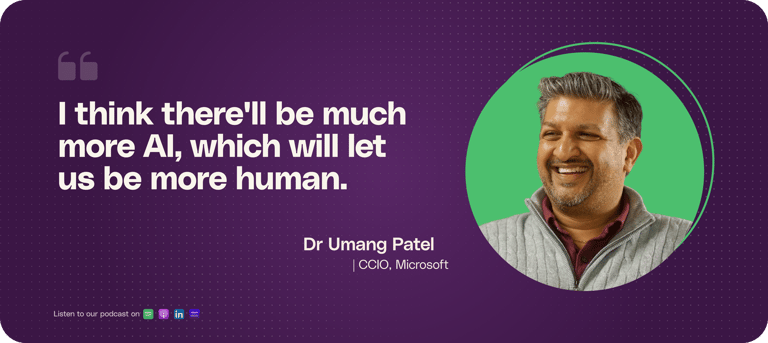
Ask Umang where this lands in five years and the answer inverts the fear most people start with. Not less human because of more AI. More human, because of it.
The chatbot doesn't replace the doctor. It gives them back the time, and the job they atually signed up for.
There's a bigger ambition sitting underneath all of this too: not just fixing the NHS, but exporting what it gets right. Great science, a rich dataset, universities that attract global talent, and a habit of collaboration that we argue the UK still does better than most. If the balance between commissioner, regulator and market gets struck properly, that's not a small prize.
The technology to send every patient home with a chatbot instead of a letter already exists. The harder work is the orchestration around it, and the culture underneath that.
This post is based on a conversation with Umang Patel, CCIO at Microsoft, on the DrDoctor Will See You Now podcast - When it Comes to Healthcare, Culture Eats Strategy for Breakfast. Listen now wherever you get your podcasts.